


The Short Answer
Mainland China: no. Operating mining hardware inside mainland China has been prohibited since 2021, and as of February 2026 the prohibition also reaches offshore providers. Under the Notice on Further Preventing and Dealing with Cryptocurrencies and Related Risks, issued on 6 February 2026 by eight regulators jointly, offshore entities and individuals are expressly barred from providing cryptocurrency-related services to persons in mainland China in any form. Marketing, traffic facilitation and payment clearing are named as well. If you are resident in the mainland, remote hosting abroad is not a workaround, and no operator — including OneMiners — should tell you otherwise.
Chinese citizens living outside the mainland: yes, in most jurisdictions. A Chinese passport holder resident in Hong Kong SAR, Singapore, the UAE, Canada, the United States, the EU, Australia or dozens of other markets can lawfully buy an ASIC miner and have it hosted in a licensed offshore data centre. That is an ordinary equipment-ownership and service-contract arrangement, and it is what the rest of this guide covers.
Read this before anything else
Your obligations follow your tax residence and physical location, not your passport alone. Citizenship, residence permits, foreign-exchange rules and reporting duties interact differently in every case. This article is general information, not legal advice. Before you commit capital, confirm your position with a qualified lawyer and tax adviser in the jurisdiction where you actually live.
What Chinese Law Actually Says in 2026
China’s position has tightened in stages over more than a decade, and the direction of travel has been consistent. Understanding the sequence matters, because a lot of outdated advice still circulates online that describes the 2021 position as if nothing has changed since.
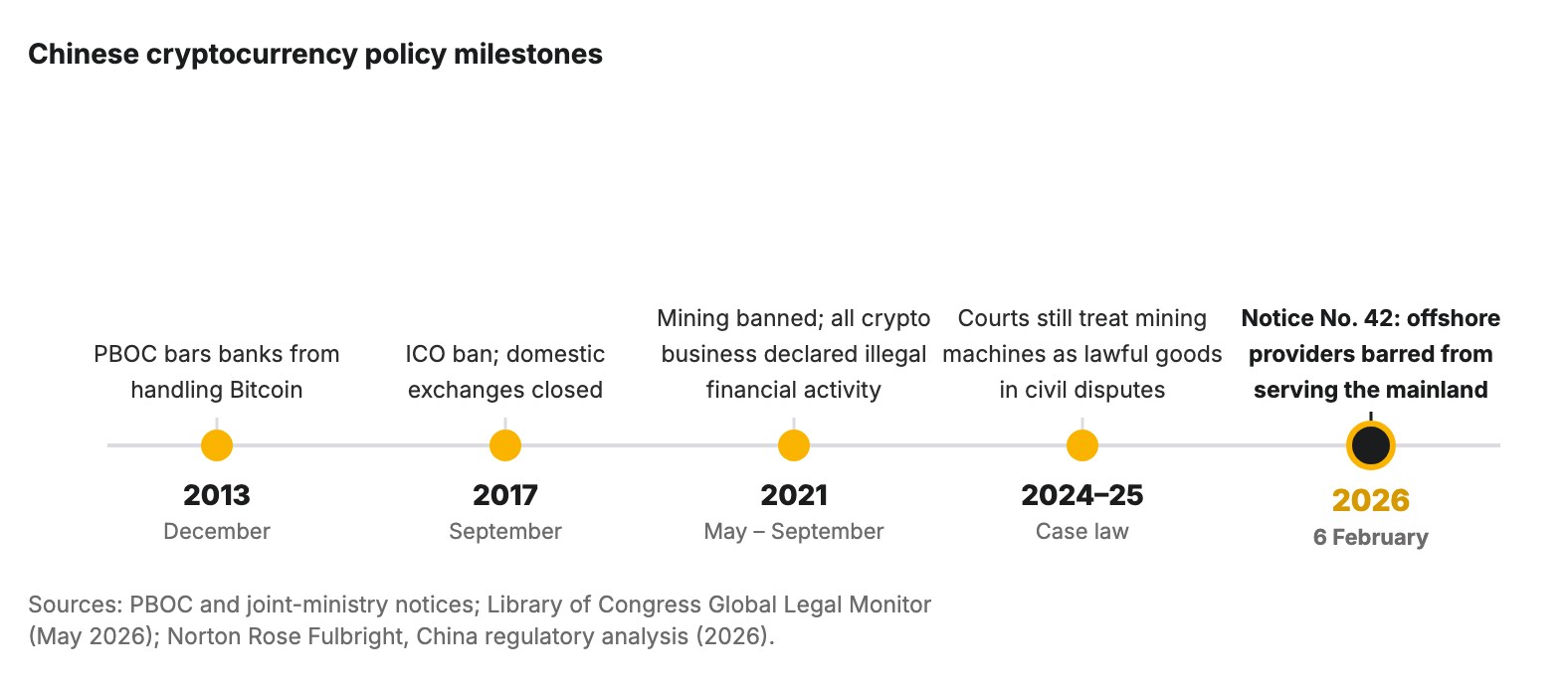
The 2026 notice is the one that changed the calculus
The February 2026 notice was issued jointly by the People’s Bank of China, the National Development and Reform Commission, the Ministry of Industry and Information Technology, the Ministry of Public Security, the State Administration for Market Regulation, the National Financial Regulatory Administration, the China Securities Regulatory Commission and the State Administration of Foreign Exchange. It took effect immediately.
Three provisions matter for anyone considering hosting abroad:
- Cryptocurrency business activity inside China remains illegal financial activity. This carries forward the 2021 framework rather than replacing its logic.
- Offshore service provision to mainland persons is now expressly prohibited. The earlier gap — where an overseas platform could argue it was outside PRC reach — has been closed. Marketing and traffic facilitation are named alongside the services themselves.
- The perimeter widened. Unapproved stablecoins, including offshore yuan-pegged tokens, and tokenisation of Chinese real-world assets abroad were brought inside the prohibition.
One nuance is worth stating precisely, because it is frequently misreported. Chinese courts have generally held that ASIC mining machines are lawful goods, so a contract to buy one can be enforceable as a matter of property and contract law. That is a statement about the hardware as an object — not a licence to operate it, and not an exemption from the financial-activity prohibition. Owning a lawful object and running a prohibited activity with it are separate questions.
Where a Chinese Passport Holder Can Legally Own and Host Hardware
The practical question is rarely “what does the passport say” and almost always “where do you actually live and pay tax.” Below is how the main destinations for Chinese nationals compare. Every one of them requires you to confirm your own position locally, but the shape of the landscape is clear.
| Where you reside | Own an ASIC? | Use offshore hosting? | What to watch |
|---|---|---|---|
| Mainland China | Hardware lawful as goods | Prohibited | Feb 2026 notice bars offshore providers from serving mainland persons. Do not proceed. |
| Hong Kong SAR | Yes | Yes | Separate legal system with a licensed virtual-asset regime. The most common base for Chinese nationals. |
| Macau SAR | Yes | Case by case | Separate system; confirm current local guidance before contracting. |
| Singapore | Yes | Yes | Clear regulatory framework. Confirm tax treatment of mining proceeds. |
| UAE | Yes | Yes | Explicit virtual-asset regulators in Dubai and Abu Dhabi. Popular with Chinese-speaking investors. |
| Canada | Yes | Yes | Mining proceeds are taxable. Keep records from day one. |
| United States | Yes | Yes | Taxable on receipt. State-level rules vary. |
| EU / EEA | Yes | Yes | MiCA governs service providers; equipment ownership is ordinary property. |
| Australia | Yes | Yes | Capital gains and income rules apply. Document your cost base. |
If you hold a Chinese passport but live and pay tax in Hong Kong, Singapore, Dubai, Toronto or Frankfurt, you are in the same position as any other resident of that market. The rest of this guide is written for you.
What Remote Hosting Actually Is
Remote hosting — sometimes called colocation — separates two things that home mining forces together: owning the machine and running the machine.
You buy the ASIC outright and hold full title to it. The unit is delivered to an industrial data centre that already has the power contract, the transformers, the cooling loop, the network and the technicians. It is racked, connected to a pool, and starts hashing. You never take physical delivery, you never import anything, and you never draw a watt from your local grid.
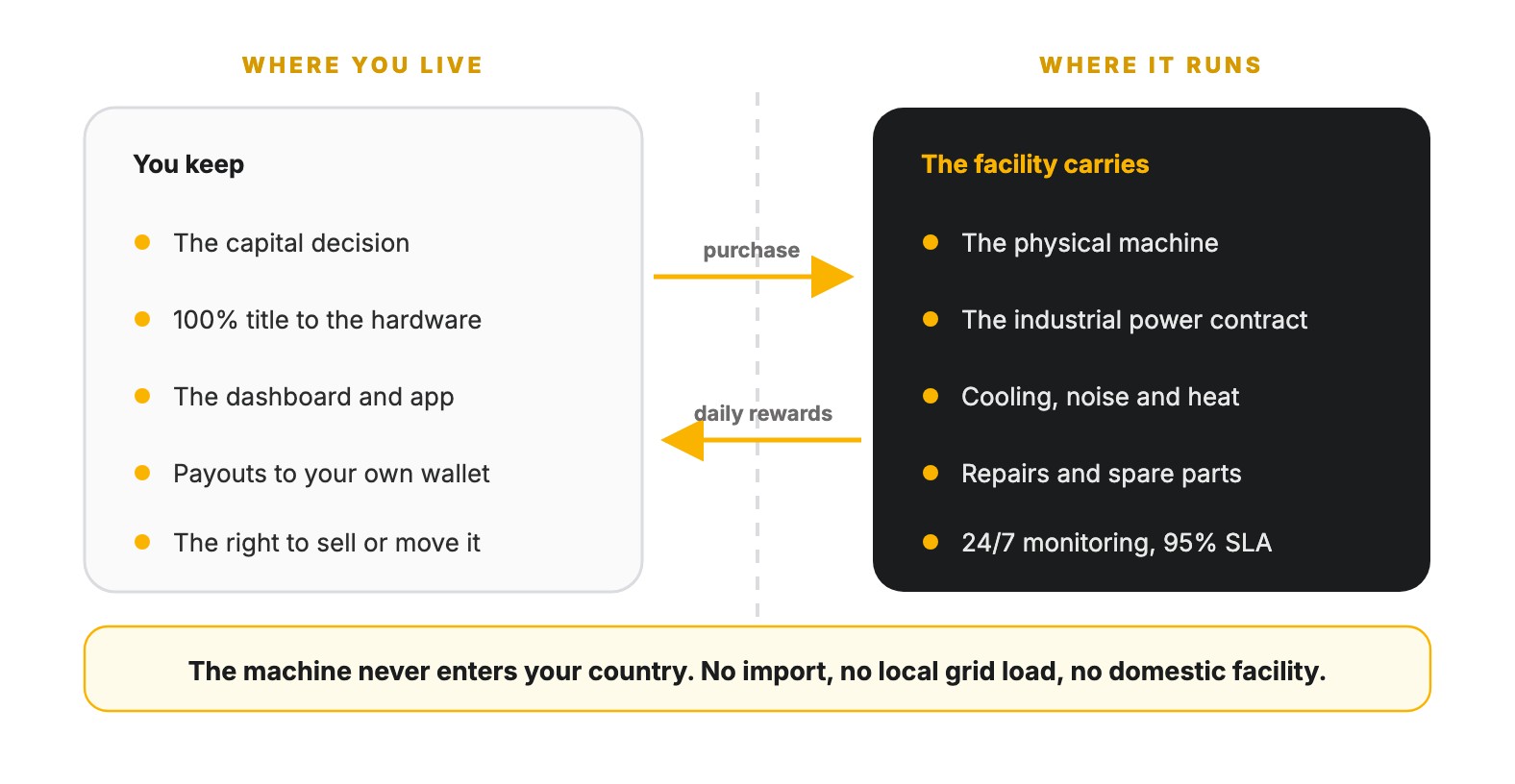
That structure is why hosting is the default for serious individual owners everywhere, not only for Chinese-speaking investors. It converts a noisy, hot, 3–11 kilowatt industrial appliance into a line item you check on your phone.
Electricity Is the Whole Argument
Reduce mining to one sentence and it is this: Profit = Revenue − (Electricity + Fees). Revenue is set by the network and the market, and nobody controls it. Fees are a negotiation. Electricity is physics, and it is where 90% or more of the total running cost sits.
That is why the location of the machine matters more than almost any other decision you make. OneMiners operates a 20-site global network totalling roughly 2,163 MW of contracted capacity at an average of $0.0480/kWh on seven-year fixed prepaid energy contracts. Those are the rates that decide whether a machine works for you or against you.
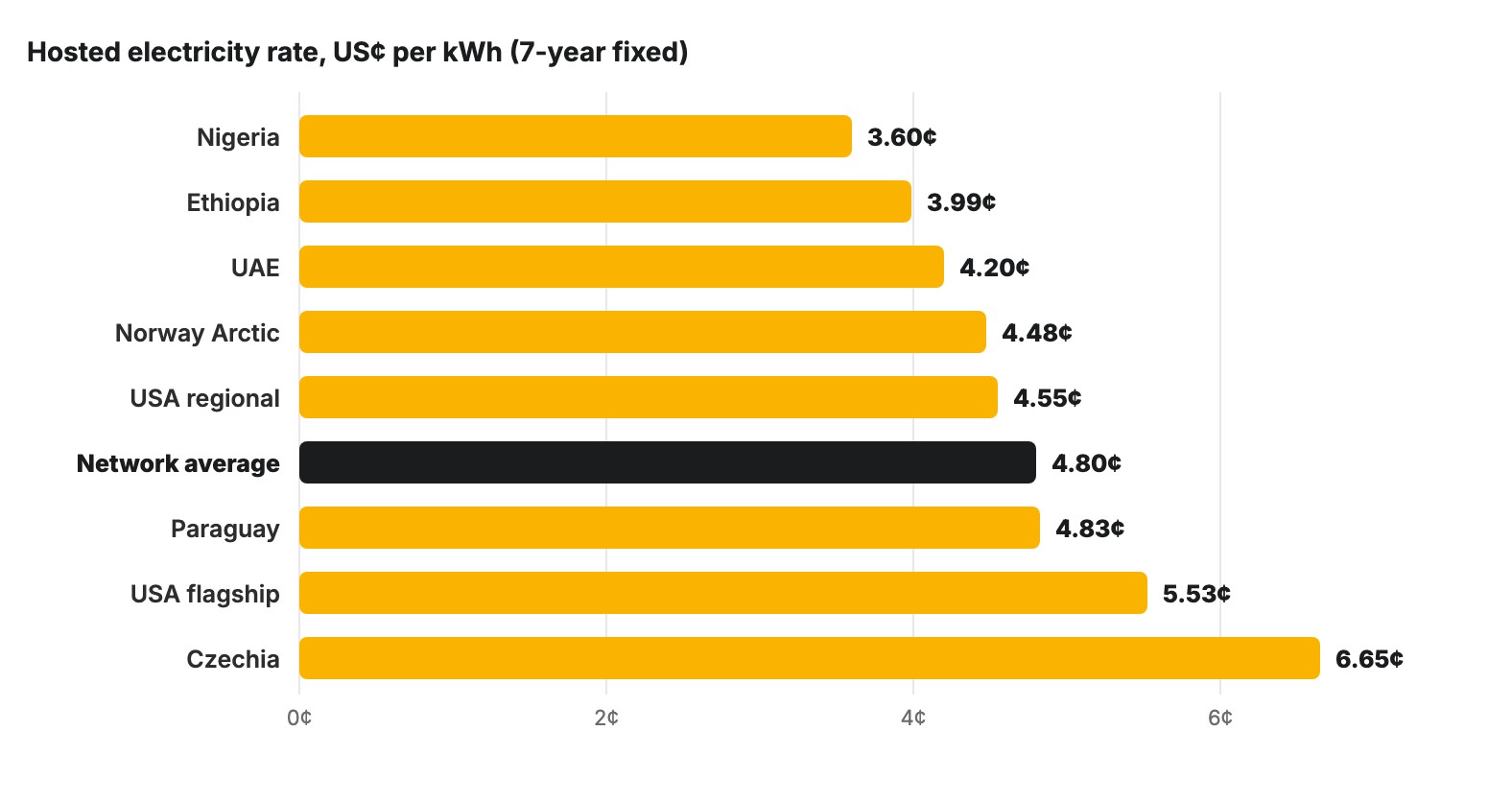
| Location | Capacity | 7-year fixed rate | Why owners pick it |
|---|---|---|---|
| Nigeria | 33 MW | $0.0360 | Lowest rate in the network; +250 MW expansion underway |
| Ethiopia | 40 MW | $0.0399 | Hydro-backed and renewable-heavy |
| UAE (Dubai & Abu Dhabi) | 34 MW | $0.0420 | Premium build, advanced cooling, strong connectivity |
| Norway (Arctic) | 36 MW | $0.0448 | Natural cold-climate cooling |
| Finland | 22 MW | $0.0448 | Cold climate, stable EU grid |
| USA regional | Multi-site | $0.0455 | New York, Georgia, South Carolina, Houston, Kansas, Texas — no install or hidden fees |
| USA flagship | 336 MW | $0.0553 | Industrial-scale flagship campus |
| Canada | 25 MW | $0.0476 | Stable North American jurisdiction |
| Paraguay | 12 MW | $0.0483 | Growing hydro-based energy infrastructure |
| Czechia | 10 MW | $0.0665 | Central-EU localised hosting |
The arithmetic that follows from those rates is simple enough to do on paper, and it is the single most useful calculation a first-time owner can perform. Take one machine, multiply its draw by 24 hours and 365 days, then multiply by the rate.
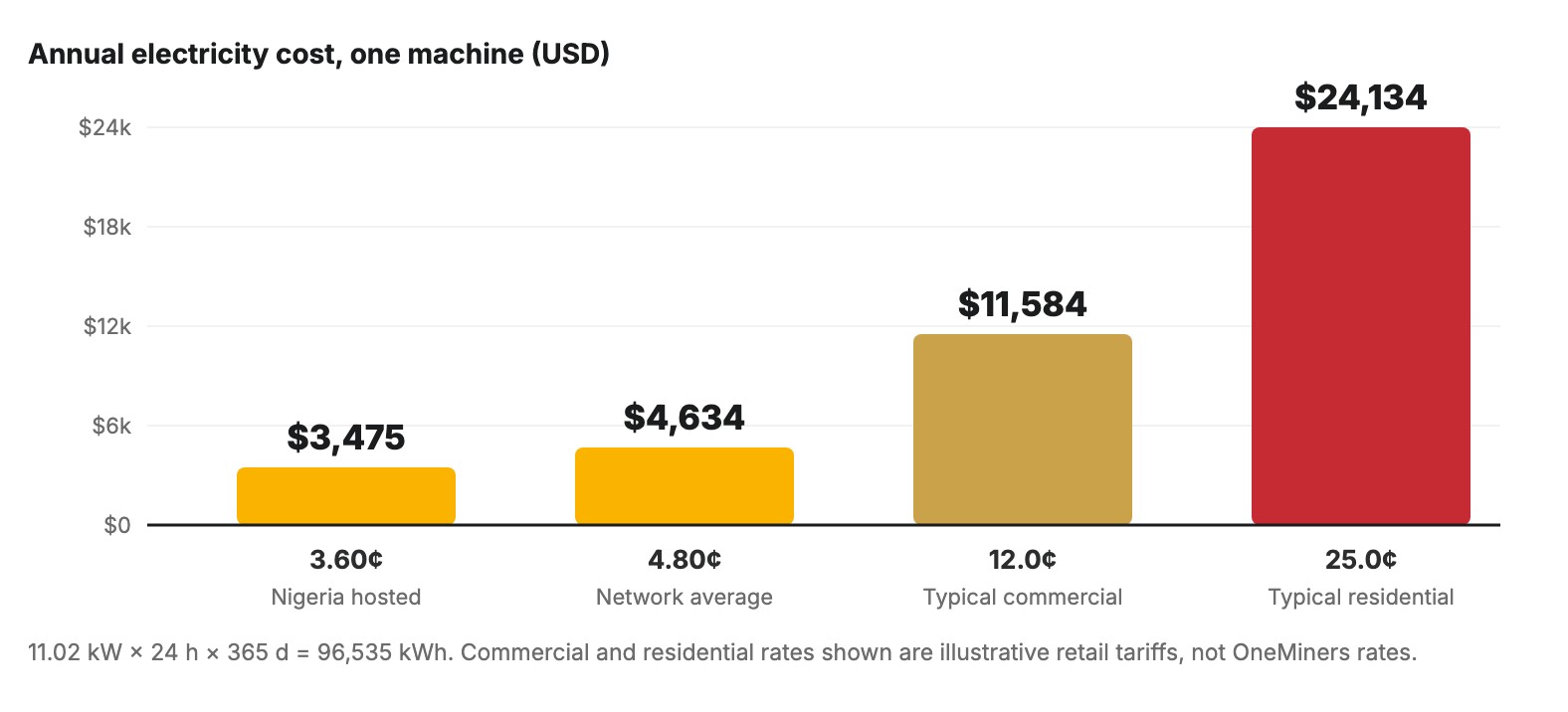
The gap between the first bar and the last is the entire reason industrial hosting exists. It is arithmetic, not marketing.
Choosing the Hardware
Once the location question is settled, hardware selection comes down to efficiency — joules per terahash — balanced against entry price. A more efficient machine converts a larger share of every kilowatt-hour into hashrate, which is what keeps it earning deeper into a difficulty cycle.
| Bitcoin miner | Hashrate | Power | Efficiency | Cooling | Price |
|---|---|---|---|---|---|
 Bitmain Antminer S23 Hyd 3UFlagship #1 Bitmain Antminer S23 Hyd 3UFlagship #1
|
1,160 TH/s | 11,020 W | 9.5 J/TH | Hydro | $14,879 |
 Antminer S21 XP HydEfficiency workhorse Antminer S21 XP HydEfficiency workhorse
|
473 TH/s | 5,676 W | 12.0 J/TH | Hydro | $6,799 |
 Antminer S21+ HYDMid-tier hydro Antminer S21+ HYDMid-tier hydro
|
358 TH/s | 5,370 W | 15.0 J/TH | Hydro | $4,764 |
 Antminer S21 XP ImmImmersion-ready Antminer S21 XP ImmImmersion-ready
|
300 TH/s | 3,900 W | 13.0 J/TH | Immersion | $3,693 |
 WhatsMiner M63SHigh hashrate, air-cooled WhatsMiner M63SHigh hashrate, air-cooled
|
406 TH/s | 7,511 W | 18.5 J/TH | Air | $2,641 |
 Antminer S21 ProBalanced entry Antminer S21 ProBalanced entry
|
234 TH/s | 3,510 W | 15.0 J/TH | Air | $2,599 |
 Antminer S19K ProLowest entry price Antminer S19K ProLowest entry price
|
105 TH/s | 2,415 W | 23.0 J/TH | Air | $274 |
Read that table from the efficiency column, not the price column. The S19K Pro has the smallest entry cost and the worst efficiency, which means it spends the most electricity per unit of work — a trade-off that only makes sense at the very lowest hosted rates. The full catalogue is available here, and you can model any combination in the OneMiners calculators before you commit.
Four Advantages That Matter for Overseas Chinese Owners
1. A global footprint, so jurisdiction is a choice
Twenty locations across Africa, the Middle East, Europe, North and South America and Central Asia mean the machine can sit in whichever jurisdiction and rate band suits you, rather than wherever you happen to live. Industrial cooling, redundant power and on-site technicians come as standard, and every site runs against the same 95% uptime guarantee with compensation.
2. Shared purchases lower the entry point
Not everyone wants to commit to a full flagship unit on a first order. Fractional and group purchasing lets several owners hold proportional shares of one high-performance ASIC and receive proportional daily payouts. It is the same machine, the same facility and the same rate — only the ticket size changes. This is how most first-time owners get comfortable with the mechanics before scaling.
3. Priority setup: hashing within two days
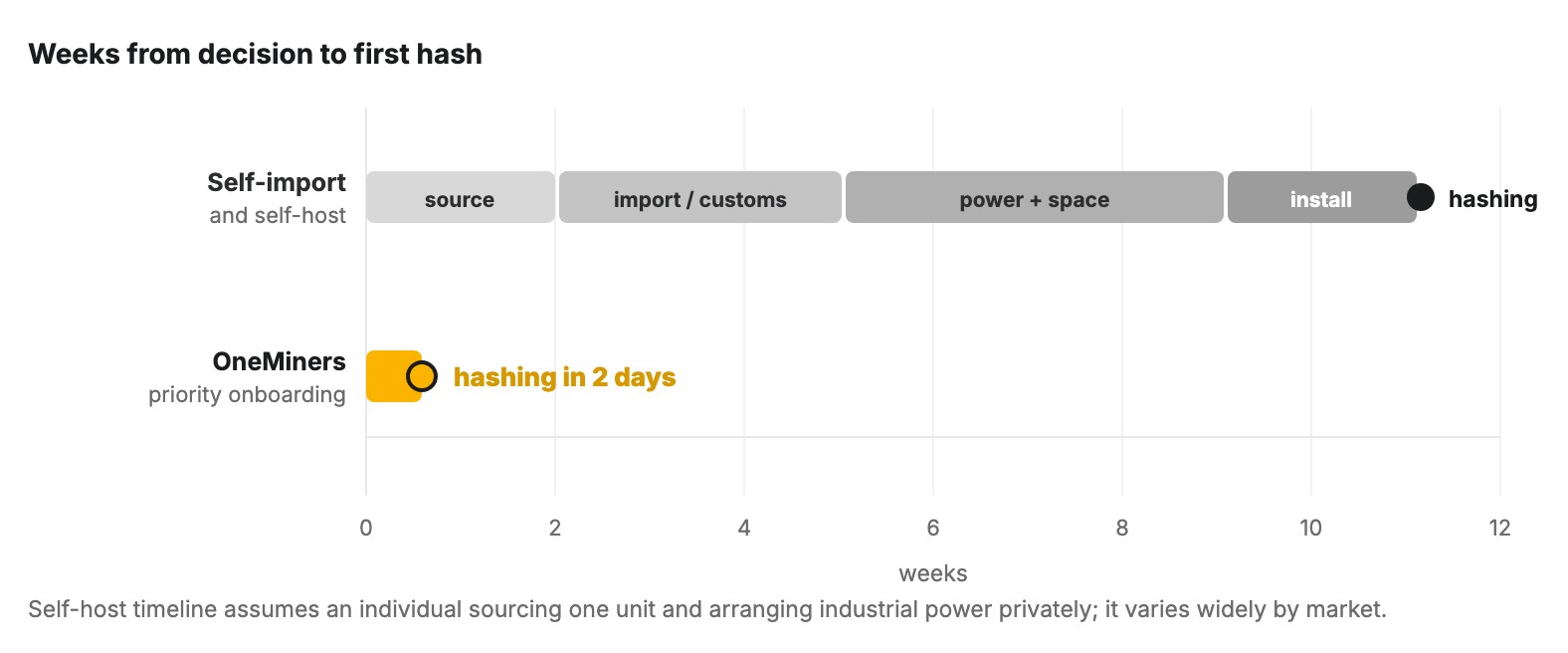
The conventional path — source a machine, import it, find power, build or rent space, commission it — takes weeks at best and often months. Express connection compresses that to two days from cleared payment to hashing, because the power, the rack and the technicians already exist.
4. A dashboard you can actually read
Hashrate, machine health, uptime and reward distribution are visible in real time in your personal dashboard and in the iOS and Android app. That transparency is the whole point of the arrangement: you should be able to verify the machine is working without taking anyone’s word for it. The full onboarding process is documented here.
| Buy and run it yourself | OneMiners hosted | |
|---|---|---|
| Electricity rate | Retail tariff, variable | From $0.0360/kWh, 7-year fixed |
| Import and customs | Your responsibility | None — unit ships to the facility |
| Noise and heat | 75–85 dB in your building | Industrial site, not your problem |
| Time to first hash | Weeks to months | 2 days with priority setup |
| Repairs | You source parts and technicians | On-site team, 7-year hardware warranty |
| Uptime | Whatever your building achieves | 98%+ typical, 95% guaranteed floor |
| Ownership | 100% yours | 100% yours |
| Entry ticket | One full unit minimum | Full unit or a fractional share |
How to Get Started in Three Steps
Select equipment
Buy a full ASIC unit, or take a share in a joint purchase. Model the options in the calculators first so the efficiency trade-off is a decision, not an accident.
Choose the hosting location
Pick the site whose rate, jurisdiction and cooling profile suit you. Every rate is fixed for seven years, so this choice compounds.
Launch
Select priority onboarding for a two-day connection. Rewards are distributed daily to your own wallet, and the dashboard is live from the first hash.
Before You Buy: Your Own Compliance Checklist
A legitimate operator should encourage this list rather than discourage it. Work through it with your own advisers.
- ✓ Confirm your tax residence — not your passport. It determines nearly everything else.
- ✓ Check whether you remain within scope of PRC rules if you spend significant time in the mainland or hold mainland registration.
- ✓ Understand cross-border payment rules that apply to you, including any foreign-exchange limits and reporting duties.
- ✓ Establish how mining proceeds are taxed where you live — income on receipt, capital gains on disposal, or both.
- ✓ Keep records from day one: invoice, serial number, hosting contract, rate schedule, and every payout.
- ✓ Verify the operator — company registration, facility locations, the actual contract, and what the SLA pays if uptime is missed.
- ✓ Read the electricity clause specifically: is the rate fixed, for how long, and what is included.
Start where the electricity is cheapest
Twenty locations, seven-year fixed rates, full ownership of the hardware, and a dashboard that shows you the machine.
Browse Bitcoin miners See hosting locationsFrequently Asked Questions
Can mainland Chinese residents legally use offshore mining hosting?
No. The 6 February 2026 notice issued by eight PRC regulators expressly prohibits offshore entities and individuals from providing cryptocurrency-related services to persons in mainland China in any form. Remote hosting abroad does not sidestep that. Anyone telling you otherwise is either out of date or not being straight with you.
I hold a Chinese passport but live in Singapore. Does that change things?
Generally yes. Obligations follow tax residence and physical location rather than citizenship alone. A Chinese national resident in Singapore is normally treated as a Singapore resident for these purposes. Confirm your specific position with a local adviser, particularly if you retain mainland ties.
Is it legal to own a Bitcoin miner in China?
Chinese courts have generally treated ASIC mining machines as lawful goods, which makes purchase contracts enforceable as property matters. That is separate from whether you may operate one or engage in crypto-related financial activity — both of which remain prohibited.
What about Hong Kong?
Hong Kong SAR has its own legal system and a licensed virtual-asset framework. It is the most common base for Chinese nationals who want a compliant route, though the specific requirements should be checked with a Hong Kong adviser before contracting.
Do I actually own the machine, or am I buying a contract?
You own the machine. Remote hosting is equipment ownership plus a service agreement, not a cloud-mining contract or a pooled investment product. You hold title, you can request its serial number, and you can sell or relocate it.
How is this different from cloud mining?
Cloud mining sells you a claim on hashrate with no identifiable machine behind it. Hosting assigns you a specific physical unit in a specific building. If a provider cannot name the machine or the site, you are not looking at hosting.
What is the minimum to get started?
A full entry-level unit starts in the low hundreds of dollars, and fractional or group purchases lower the ticket further by letting you hold a proportional share of a higher-performance machine with proportional daily payouts.
How quickly can a machine start hashing?
Two days from cleared payment with priority onboarding. Standard onboarding depends on batch and site availability.
What happens if a machine fails?
On-site technicians handle diagnosis and repair, and hardware is covered by a seven-year warranty. Uptime carries a 95% guaranteed floor with compensation, against 98%+ typical performance.
Where do the mining rewards go?
Rewards are distributed daily to the wallet you nominate. You are responsible for the tax treatment of those receipts where you live.
Which location should I choose?
If the only variable you care about is cost, Nigeria carries the lowest seven-year fixed rate in the network at $0.0360/kWh. If you weight jurisdictional familiarity or connectivity more heavily, the UAE and the US sites are the usual choices. All rates are on the hosting page.
Are returns guaranteed?
No, and any operator promising guaranteed returns should end the conversation for you. Mining revenue moves with Bitcoin price, network difficulty, transaction fees, machine efficiency and uptime. The costs are knowable in advance; the revenue is not.
Final Takeaway
The honest version of this topic is shorter than the marketing version. If you are resident in mainland China, the February 2026 framework closed the offshore route and there is no compliant path for you today. If you are a Chinese citizen living in Hong Kong, Singapore, Dubai, Canada, the United States, Europe or Australia, you can own an ASIC outright, have it hosted at an industrial rate in whichever jurisdiction suits you, and watch it work from your phone — the same as any other owner in that market.
Electricity is the argument. Everything else is logistics.
Revenue is weather. Fees are a negotiation. Electricity is physics.
Resources and Sources
Legal sources cited: Library of Congress, Global Legal Monitor, “China: Cryptocurrency Ban Extended to Stablecoins and RWA Tokenization” (21 May 2026); Norton Rose Fulbright, “China rolls out updated crypto framework” (2026); People’s Bank of China and seven other departments, Notice on Further Preventing and Dealing with Cryptocurrencies and Related Risks, No. 42 [2026], issued 6 February 2026.