


ONEMINERS - THE BREAK-EVEN LINE
Is Bitcoin Mining Still Worth It in 2026?
Yes, above one specific electricity price, and no below it. That line is sharper in 2026 than it has ever been, and it is easy to work out exactly where you sit on it.
One threshold decides it. Everything else is detail.
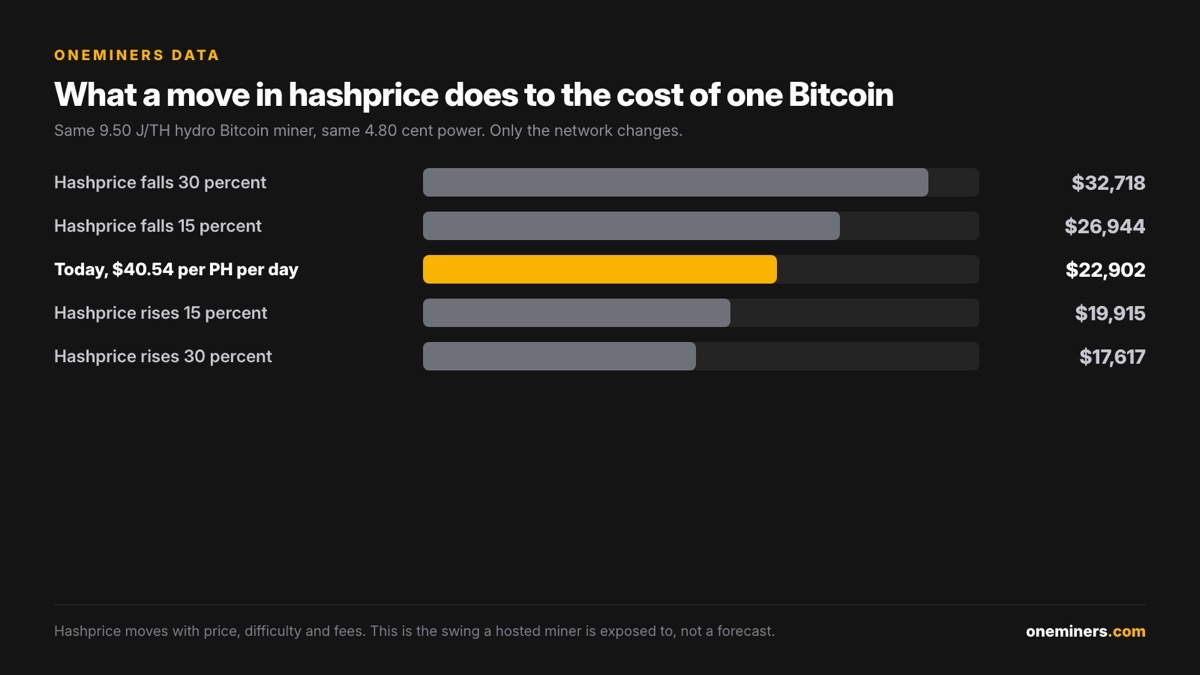
The Bitcoin network is running at about 950 EH/s, difficulty sits at 132.76 trillion at block height 967,975, and the next retarget is pointing down 2.0 percent. With Bitcoin near $84,834, hashprice works out at roughly $40.54 per petahash per day. Difficulty and height are from the live chain, price from blockchain.info, the retarget estimate from mempool. Those are the only four inputs anyone needs.
So, is it still worth it? The honest answer is that the question has no general form. Mining is not a single business with a single margin. It is a machine converting electricity into Bitcoin at a fixed exchange rate set by the network, and whether that trade is good depends on what you pay for the electricity going in. There is a precise price at which it stops working, and you can calculate yours in about thirty seconds.
Two things worth knowing before the arithmetic. First, mining is measurably cheaper than it was a year ago: difficulty peaked at 155.97 trillion on 30 October 2025 and now sits at 132.76 trillion, a fall of about 14.9 percent, so the same machine earns roughly 17.5 percent more Bitcoin per hash than it did at the top. Second, the next retarget is pointing down again. The squeeze story that dominates the headlines is real for operators on expensive power and simply not true for operators on cheap power.
Key takeaways
First, the stakes: what a wrong power price actually costs
Electricity is 75 to 85 percent of the ongoing cost of running an ASIC. Rack space, technicians, cooling maintenance, insurance and monitoring are rounding errors next to it. That is why almost every honest question about mining collapses into one question about your power bill.
One machine makes it concrete. A Antminer S23 Hyd drawing 5,510 watts costs $6.35 a day in electricity at 4.80 cents, and $22.48 a day at 17 cents. Across a year that is a difference of $5,889 on a single unit. The machine cost $12,299. The power price difference outruns the purchase price inside two years.
How to tell in thirty seconds whether it is worth it for you
Take your machine's efficiency in joules per terahash. Divide today's hashprice by 24 times that number. The result is the highest electricity price at which your machine still covers its own power:
break-even dollars per kWh = hashprice / (24 x J/TH)
If your actual rate is below that, mining works. If it is above, every hour the machine runs costs more than it makes. At today's hashprice of $40.54 per petahash per day a 9.50 J/TH machine breaks even at $0.1778, a 12.00 J/TH machine at $0.1408, and a 17.50 J/TH machine at $0.0965. That is the whole test.
Worth it or not, ranked by where the machine actually sits
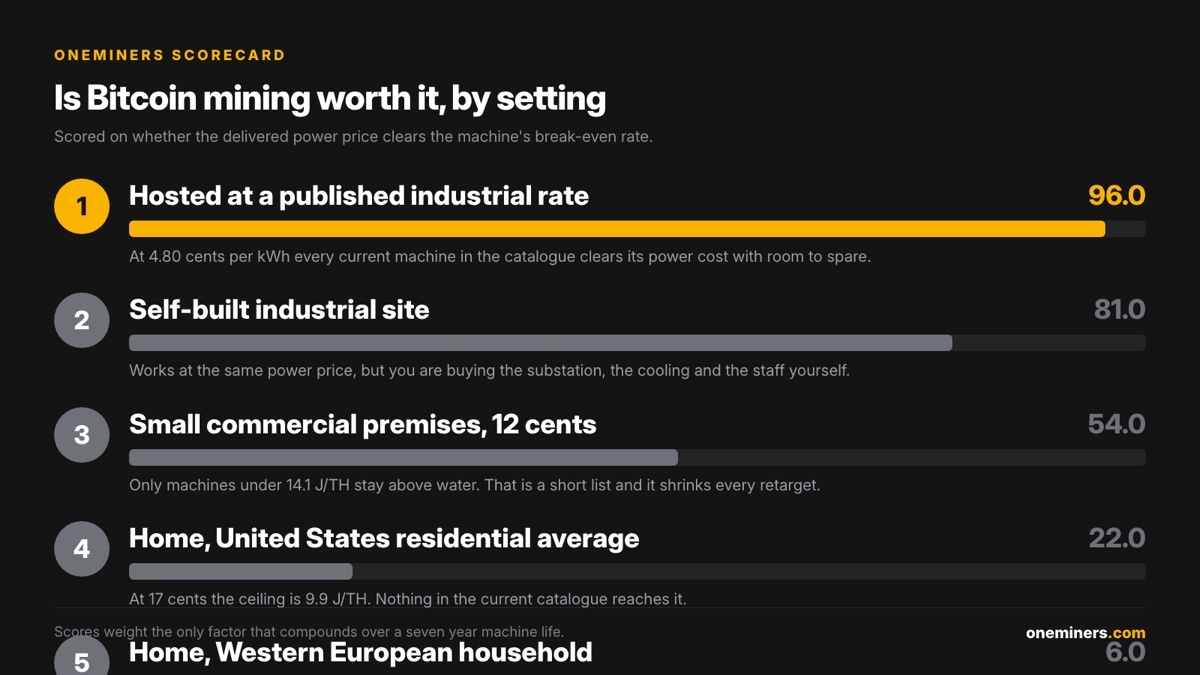
Five realistic places to run a Bitcoin miner in 2026, scored on whether the arithmetic works rather than on how the setup looks.
1. Hosted at a published industrial rate, the clear winner
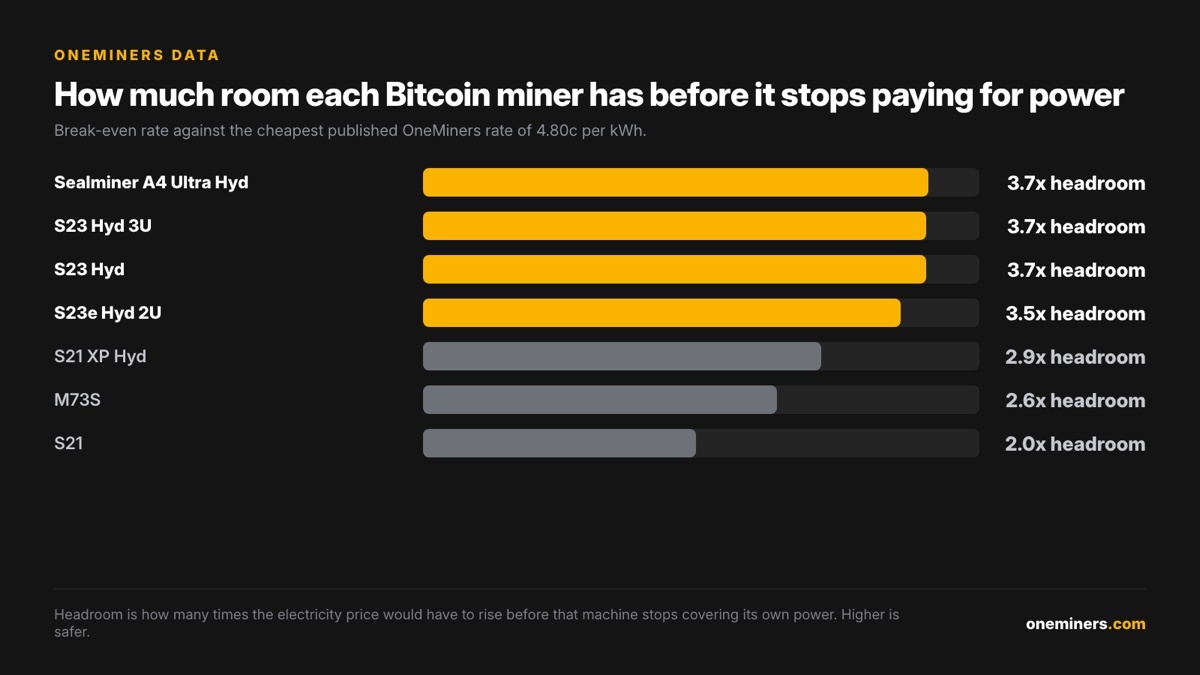
Verdict: the only option on this list where every machine in the current catalogue is above its break-even line with real headroom. Hosting from 4.80 cents per kilowatt hour, and 3.64 cents on a seven year prepaid contract at the Nigeria hosting center, sits roughly a quarter of the way to the break-even rate of a modern hydro unit. Independent hosts that publish their rates at all start closer to 5.9 cents. You also skip the substation, the cooling plant, the noise and the technicians.
2. A self-built industrial site
Verdict: the arithmetic works, the capital requirement usually does not. You can reach an industrial power price if you build at industrial scale, but you are then also buying transformers, cooling, fire suppression, security and a payroll. It is a different business from mining, attached to mining.
3. Small commercial premises at around 12 cents
Verdict: marginal, and getting worse. At 12 cents the ceiling is 14.1 J/TH. Today's best machines are under 10 J/TH so they clear it, but the margin is thin, a single upward retarget eats a chunk of it, and the 2028 halving closes it entirely. Workable as a short hold, not as a seven year plan.
4. Home, at an average United States residential rate
Verdict: the arithmetic does not work. At 17 cents you need a machine under 9.9 J/TH and nothing on the market is close. A machine plugged in at home on an average residential tariff runs at a loss on electricity alone, before you count the noise, the heat and the wiring.
5. Home, on a Western European household tariff
Verdict: no, by a wide margin. At a German household rate of about 38 cents, the electricity needed to produce one Bitcoin costs roughly $181,311, which is more than twice what the coin is worth. That is not a close call or a matter of patience. It is a losing trade on every unit of electricity.
The same question as a table
| Bitcoin miner | Efficiency | Breaks even at | Net over power at 4.80 cents | Net over power at 17 cents |
|---|---|---|---|---|
 Antminer S23 Hyd 3U Antminer S23 Hyd 3U |
9.50 J/TH | $0.178/kWh | $34.33/day | $2.06/day |
 Sealminer A4 Ultra Hyd Sealminer A4 Ultra Hyd |
9.45 J/TH | $0.179/kWh | $26.27/day | $1.76/day |
 Antminer S23e Hyd 2U Antminer S23e Hyd 2U |
10.00 J/TH | $0.169/kWh | $25.10/day | $-0.23/day |
 Antminer S23 Hyd Antminer S23 Hyd |
9.50 J/TH | $0.178/kWh | $17.16/day | $1.03/day |
 WhatsMiner M73S WhatsMiner M73S |
13.50 J/TH | $0.125/kWh | $13.99/day | $-8.14/day |
 Antminer S21 XP Hyd Antminer S21 XP Hyd |
12.00 J/TH | $0.141/kWh | $12.64/day | $-3.98/day |
 Antminer S21 Antminer S21 |
17.50 J/TH | $0.097/kWh | $3.83/day | $-5.80/day |
Revenue minus electricity only. A negative figure means the machine burns more electricity than it earns. Hashprice $40.54/PH/day, 21 September 2026.
Read the last column carefully. At a United States household rate every single machine in the catalogue is negative. Not marginal. Negative. That column is the reason industrial hosting exists as an industry.
Is it worth it, scored by setting
Scored on whether the power price clears the break-even line, not on scale or branding.
Scores weight the only factor that compounds over a seven year machine life: delivered electricity price against break-even rate.
Hardware that is above the line today
Sealminer A4 Ultra Hyd$9,999Hashrate886 TH/sEfficiency9.45 J/THPower draw8,372 WBreaks even at$0.179/kWhPower at 4.80 cents$9.64/dayView listing
Antminer S23e Hyd 2U$19,440Hashrate865 TH/sEfficiency10.00 J/THPower draw8,650 WBreaks even at$0.169/kWhPower at 4.80 cents$9.96/dayView listing
Antminer S21 XP Hyd$6,199Hashrate473 TH/sEfficiency12.00 J/THPower draw5,676 WBreaks even at$0.141/kWhPower at 4.80 cents$6.54/dayView listing
Live catalogue listings. Efficiency derived from published wattage divided by hashrate.

Red flags that mean it is not worth it
Final thoughts
Bitcoin mining in 2026 is worth it at an industrial electricity price and is not worth it at a household one, and the gap between those two answers is wider than at any point in the network's history. Difficulty falling 14.9 percent from its peak has handed every operator about 17.5 percent more Bitcoin per hash, but that tailwind is shared equally and it does not rescue anyone paying 17 cents. Revenue is weather. Difficulty is a negotiation with everyone else. Electricity is the one term on the contract you can actually sign.
Find your line: check a rate, pick a Bitcoin miner, and run the break-even formula before you buy anything.
Compare hosting locationsBrowse the miner catalogueFrequently asked questions
Is Bitcoin mining still worth it in 2026?
At an industrial or hosted electricity rate, yes. At 4.80 cents per kilowatt hour every current machine covers its power with margin. At an average United States household rate of 17 cents, no current machine breaks even on electricity alone.
What electricity price do I need for mining to work?
Below your machine's break-even rate, which is hashprice divided by 24 times its J/TH. Today that is about $0.178 per kilowatt hour for a 9.50 J/TH machine and $0.097 for a 17.50 J/TH machine.
Has mining got better or worse over the past year?
Better on the network side. Difficulty is down about 14.9 percent from its 30 October 2025 peak, so the same hardware earns roughly 17.5 percent more Bitcoin per hash than it did then.
Is hosting better than mining at home?
On arithmetic, yes, and it is not close. The power price gap between a household tariff and an industrial hosted rate is larger than every other cost in the operation combined.
What happens at the 2028 halving?
Every break-even rate on this page halves. A 9.50 J/TH machine that breaks even at $0.178 today would break even near $0.089 after the halving, unless price or fees rise to compensate.
Informational only, not financial advice. Every figure above is a snapshot taken on 21 September 2026 and is derived from the live Bitcoin network and the live OneMiners catalogue. Mining revenue moves with price, difficulty and transaction fees, and can fall as well as rise. No fixed return is offered or implied. Do your own research before buying hardware or hosting.
