


How to Convert a Bitcoin ASIC into an AI Server: Complete Guide, Technical Reality, and the Only Working Method for 2026
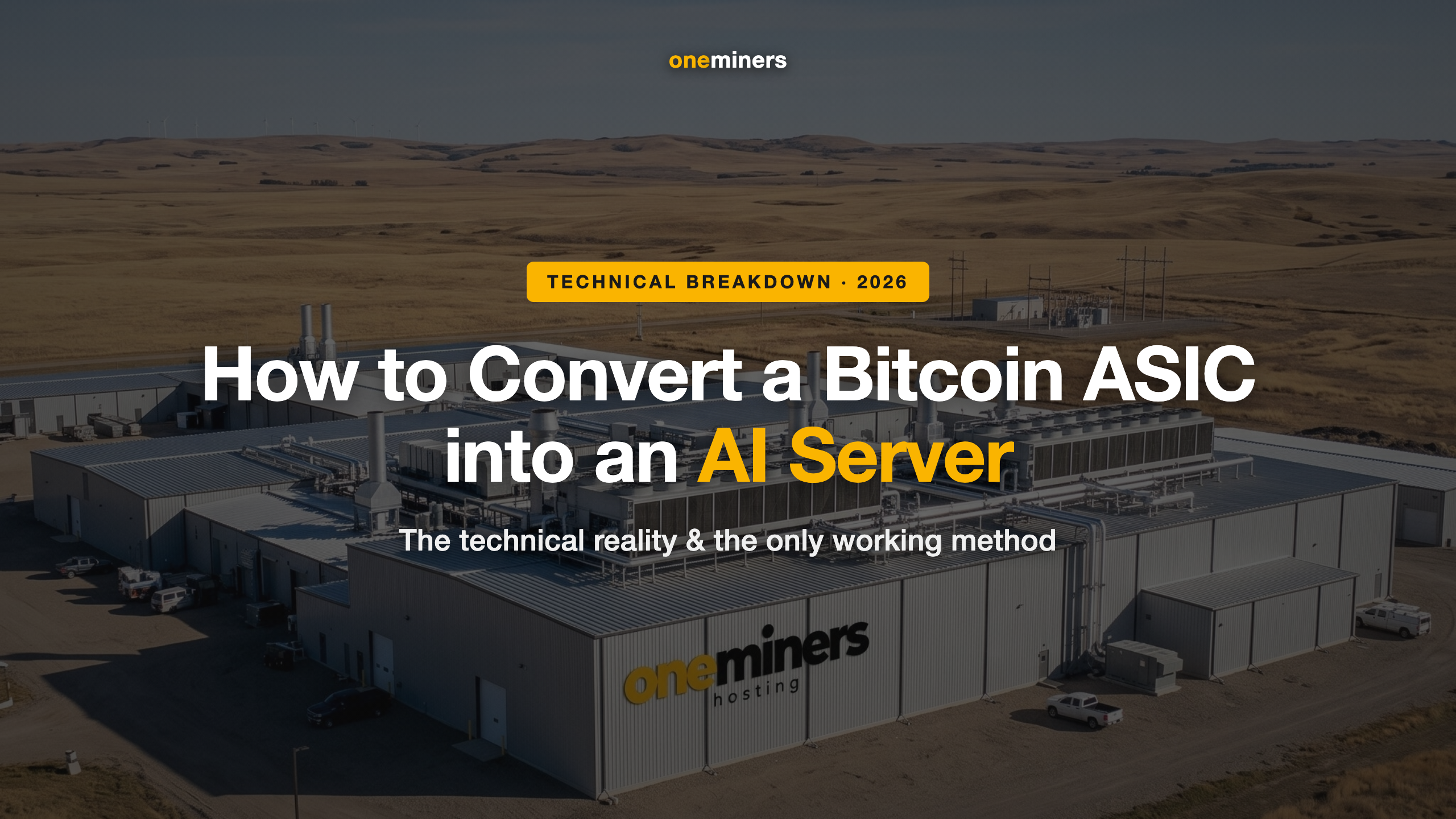
Billions of dollars in decommissioned mining hardware are gathering dust in warehouses while the world starves for AI computing power. Is it possible to “reflash” an Antminer to run ChatGPT and spin up an AI cloud right inside a mining farm?
1. Introduction: The Tempting Illusion of Millions in Savings
Every mining farm operator and holder of decommissioned ASIC devices — the Antminer S19 or S21, for example — has toyed with this idea. Across Reddit, Bitcointalk, and Telegram, the same debate rages on: “We have gigawatts of power infrastructure, industrial-grade cooling, and thousands of chips running massive parallel operations. Why can’t we simply flash a custom Linux firmware with PyTorch and rent out this compute for AI model training?”
Media headlines only add fuel to the fire: “Major Bitcoin Miners Pivot to AI, Generating Billions in Revenue.” It feels as though the solution is within arm’s reach — just a few CLI commands away. But what is the engineering reality? In this teardown we strip away the hype, break silicon architecture down to the atomic level, and reveal the only technically and economically viable roadmap for transforming a crypto mining operation into an AI cloud.
The short version, before we prove it: you cannot firmware-flash your way to AI. But the facility around those miners — its high-voltage power, cooling, and real estate — is one of the most valuable assets in the entire AI buildout. That distinction is the whole article. Operators who understand it are landing multi-billion-dollar deals; operators who don’t are still trying to SSH into a control board. Professional hosting platforms like OneMiners already sit on exactly the infrastructure the AI era is scrambling to secure.
2. The Silicon Wall: Why You Cannot Firmware-Flash an ASIC for AI
To understand the core bottleneck, look at what the acronym actually stands for: ASIC — Application-Specific Integrated Circuit. The clue is in the name.
The Fundamental Hardware Constraint
A Bitcoin ASIC is not a GPU, and it is not a general-purpose CPU. It possesses zero instruction sets. Its logic transistors are physically hardwired into the silicon to execute precisely one mathematical function: double SHA-256 hashing, SHA256(SHA256(BlockHeader)). There is no operating system to persuade, no software layer to rewrite — the “program” is etched into the metal itself.
| Feature | Bitcoin ASIC (Antminer S19/S21) | GPU / AI Accelerator (Nvidia H100) | Dedicated AI ASIC (Groq / Google TPU) |
|---|---|---|---|
| Primary Purpose | SHA-256 hash execution only | Universal parallel matrix math | Tensor / matrix multiplication (LLMs) |
| Math Operations | Bitwise shifts, XOR, AND, ADD32 | FP16 / FP8 / INT8 matrix math | Ultra-large matrix ops (tensor cores) |
| On-Board Memory (VRAM) | None (a few KB SRAM) | 80–144 GB HBM3 / HBM3e (3.3 TB/s) | ~230 MB SRAM per chip (80 TB/s) |
| Reprogrammability | 0% (hard-etched in silicon) | 100% (CUDA, PyTorch, C++) | 100% (custom domain compilers) |
Lower is not better here — the ASIC column is simply built for a different universe. Reprogrammability is 0%. That number does not move.
Why Memory Is the Ultimate Dealbreaker
Running large language models, image generators, or computer-vision networks requires loading billions of weights into high-bandwidth memory at blistering speeds. A Bitcoin ASIC has no external VRAM whatsoever. It lacks the physical memory channels to hold even 0.01% of a model like Llama-3 or GPT-4. Even if you could somehow feed it instructions, there is nowhere to put the model.
Trying to run an AI neural network on a Bitcoin ASIC is like forcing a mechanical meat grinder to play a music CD — and arguing it should work because “both devices have rotating parts inside.”
3. What About the Control Board? The Linux / BeagleBone Route
Hardware enthusiasts often push back: “But the control board on an Antminer runs full-fledged Linux! We can SSH into it!” That much is true — and it is also a dead end.
The control board represents less than 0.1% of the device’s actual compute capability and value. It is merely a low-cost microcontroller tasked with fetching work from a pool, distributing job assignments to the hash boards, and managing fan speeds. Running an AI model on it gives you the performance of a decade-old budget smartphone — while the actual hash boards, holding hundreds of ASIC chips, sit completely idle, burning electricity for nothing.
The control-board reality check
- Yes, it runs Linux — and yes, you can SSH in.
- No, it cannot train or serve a model at any useful speed.
- The 99.9% of the machine that matters (the hash boards) does nothing for AI.
- You end up paying data-center power to run a glorified smartphone.
4. The Only Working Method: The Infrastructure Pivot (HPC Pivot)
So how are industrial miners like Core Scientific, Hut 8, and Hive Digital landing multi-billion-dollar deals with AI giants? The transformation is very real — but it involves overhauling the physical site infrastructure, not rewriting chip firmware. The miners are not being converted. The facilities are.
Step 1Power Conversion — The True Asset
Securing 50–100 MW of grid interconnects for a new AI data center currently takes 3 to 5 years because of transformer queues and utility red tape. Crypto miners already own operational high-voltage substations — which account for roughly 80% of the friction in any AI deployment. The energized megawatts are the prize, not the machines plugged into them.
Time to Energize a New AI Data Center
The hardest part of AI infrastructure is the power — and mining sites already cleared it.
Sources: transformer-queue and interconnect lead times, 2026 industry conditions.
Cooling Overhaul
High-decibel air cooling built for ASICs cannot handle dense AI server racks that draw 40–100 kW each. Facilities must be retrofitted for direct-to-chip liquid cooling or second-generation immersion systems — the same thermal engineering that already gives hydro and immersion mining sites their edge.
Step 3Networking Overhaul
Mining requires negligible bandwidth (~10 Mbps). LLM cluster training requires ultra-low-latency NVIDIA Quantum-2 InfiniBand or 400GbE switching to bind thousands of GPUs into a single coherent supercomputer. This is a networking layer added on top of the site, not a firmware tweak.
Step 4ASIC Eviction and AI Accelerator Mounting
Legacy Antminers are cleared out entirely. The empty shelves are replaced with industrial server racks housing Nvidia HGX H100 / B200 nodes or specialized AI accelerators such as Google TPU v5e or Groq LPUs. The building stays; the silicon inside it changes completely.
5. Why OneMiners’ Infrastructure Is Built for the AI Era
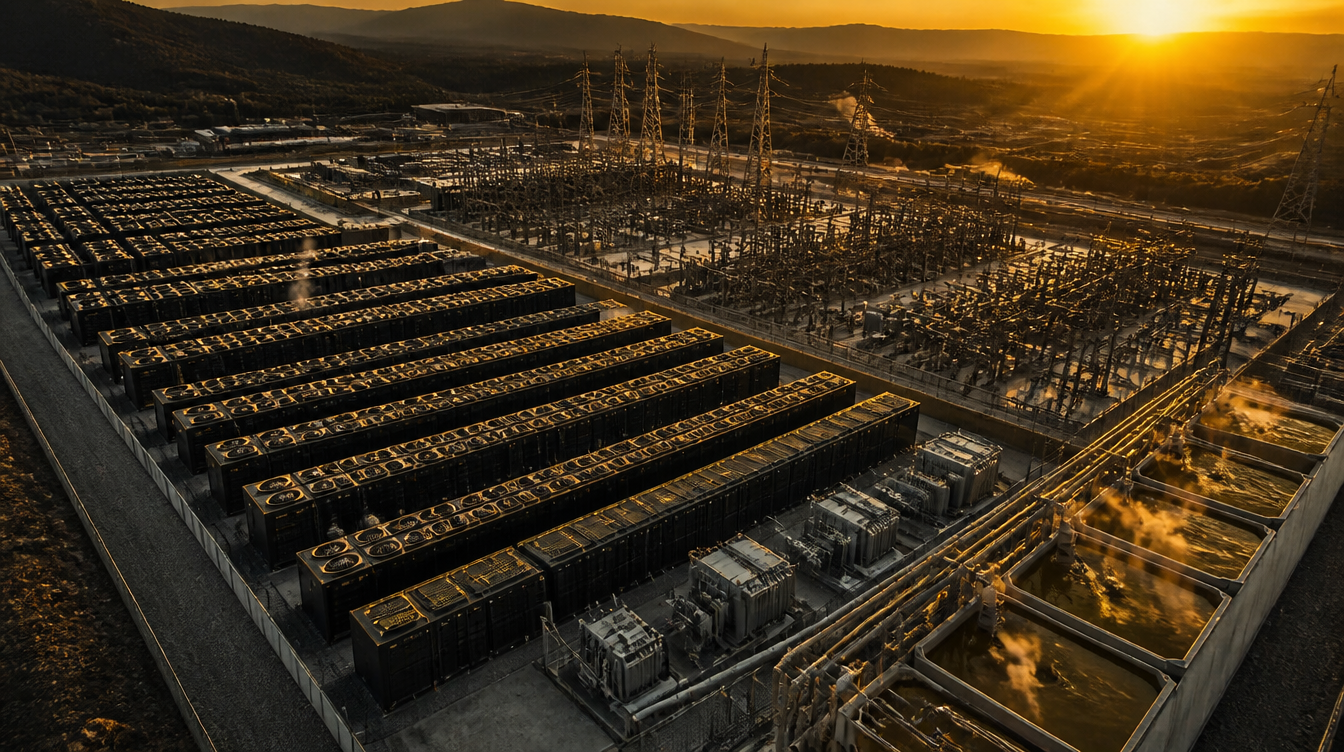
Read the four-step blueprint again and one thing becomes obvious: the hard part — the part that takes years and hundreds of millions of dollars — is the power and cooling, not the racks. That is precisely where OneMiners already operates. The platform runs 1,964 MW of energized, industrial-grade capacity across six countries, with a build pipeline pushing toward roughly 2 GW — the exact foundation the AI buildout is racing to secure.
What makes a mining facility “AI-ready” — and where OneMiners already stands
- Energized high-voltage substations — the 3-to-5-year grid wait is already behind us.
- Hydro and immersion cooling — the same dense-heat engineering AI racks demand.
- Low, fixed electricity — from $0.0364/kWh in Nigeria to $0.0455/kWh in the USA, on 7-year fixed contracts.
- Global footprint — ~20 locations across Nigeria, Ethiopia, the UAE, USA, Norway and Finland.
- 95%+ uptime SLA (98%+ measured globally), with insurance and real-time monitoring included.
| Location | Capacity | Electricity | Cooling Edge |
|---|---|---|---|
| USA (flagship) | 336 MW | $0.055/kWh | Air + hydro |
| Ethiopia | 40 MW | $0.0399/kWh | Hydro |
| UAE (Dubai) | 34 MW | $0.042/kWh | Immersion |
| Nigeria | 33 MW | $0.0364/kWh | Air + immersion |
| Norway / Finland | Renewable | $0.0448/kWh | Free-air / hydro |
Representative sites from a ~2 GW / ~20-location network. The megawatts and the cooling are the asset — and they are already live.
The point is not that OneMiners flips a switch and becomes an AI cloud tomorrow. The point is structural: the years-long, capital-heavy groundwork that gates every new AI data center — interconnects, substations, dense-heat cooling, real estate at cheap power — is exactly the groundwork a serious hosting operator has already laid. Whether those megawatts host the world’s most profitable Bitcoin miners today or high-density AI accelerators tomorrow, the foundation is the same.
6. Alternative Paths for Smaller Mining Operations (DeAI)
If you don’t have tens of millions in capital to deploy Nvidia H100 clusters, there are still ways for smaller operations to tap into the AI boom — without pretending an Antminer can do the work:
Three realistic on-ramps
- GPU compute sharing (Render Network, Akash, Bittensor) — repurpose consumer or enterprise GPU rigs (RTX 3090/4090) to supply decentralized AI inference and rendering.
- True random number generation (TRNG) — a niche market where research labs occasionally procure ASICs for high-speed physical entropy in Monte Carlo simulations.
- Colocation hosting — lease your high-density power capacity and rack space to third-party AI workloads instead of building the AI stack yourself.
Notice that two of the three are about selling the infrastructure, not the ASICs. The lesson keeps repeating itself. If you want to run the numbers on what your hardware still earns as a Bitcoin miner in the meantime, tools like asicprofit.com and the fundamentals explainers at btcfq.com are the honest place to start.
7. FAQ: Converting ASICs and Mining Facilities to AI
1. Can I flash custom firmware to make an Antminer run AI?
No. A Bitcoin ASIC has zero instruction sets and no external memory — its transistors are hard-etched for SHA-256. There is no firmware patch that changes the physics of the silicon.
2. But the control board runs Linux — doesn’t that help?
Only trivially. The control board is a low-cost microcontroller worth under 0.1% of the machine’s compute. Running AI on it performs like a decade-old budget phone while the hash boards sit idle.
3. Then how are Core Scientific, Hut 8, and Hive making AI deals?
They are converting facilities, not chips — repurposing power, cooling, real estate and grid interconnects, then installing GPUs. The mining hardware is evicted, not reflashed.
4. What is actually the valuable asset in a mining farm?
The energized high-voltage power. Securing 50–100 MW of new grid capacity can take 3–5 years; an operating mining site already has it, which removes roughly 80% of the friction in an AI deployment.
5. Why can’t ASIC cooling be reused as-is?
ASIC air cooling is built for its own thermal profile. Dense AI racks draw 40–100 kW each and need direct-to-chip liquid or immersion cooling — which is why hydro and immersion mining sites have a head start.
6. Do I need special networking for AI?
Yes. Mining needs ~10 Mbps; LLM training needs ultra-low-latency InfiniBand or 400GbE to link thousands of GPUs into one supercomputer.
7. Is there any use for a decommissioned ASIC besides Bitcoin?
Very few. High-speed true random number generation is a small niche. Otherwise, an ASIC mines SHA-256 coins or it is scrap — it cannot be repurposed for general compute.
8. What can a smaller operator do to join the AI economy?
Repurpose GPU rigs into decentralized networks (Render, Akash, Bittensor), or lease power and rack space via colocation. Sell the infrastructure, not the ASICs.
9. Does this mean Bitcoin mining is over?
No. It means the site is dual-purpose real estate. The same megawatts and cooling that host today’s most efficient miners are the foundation AI data centers are built on — which is exactly how a platform like OneMiners is positioned.
10. Where can I host miners at AI-grade infrastructure today?
Professional hosting platforms with energized substations, immersion/hydro cooling and low fixed electricity — such as OneMiners — give you the same industrial foundation, whether you’re running Bitcoin ASICs now or planning for high-density compute later.
You cannot reflash silicon. You can own the power it runs on.
The Final Verdict
There is no firmware patch that will ever turn an Antminer into an AI server. SHA-256 silicon will remain SHA-256 silicon forever. But the mining facility around it — its high-voltage power, real estate, and thermal-management capacity — is the ultimate foundation upon which modern AI data centers are built. The operators who win the next decade are the ones who already control energized, well-cooled, low-cost megawatts. That is not a firmware question. It is an infrastructure one — and it is a question OneMiners has already answered.