


How Hackers Stole Millions in Bitcoin — And 5 Simple Ways to Keep Yours Safe
Here is a scary headline you may have seen this week: hackers quietly drained more than $100 million worth of Bitcoin from thousands of people’s wallets. It sounds like something out of a movie — and it is genuinely serious — but the actual story is simpler than the headlines make it look.
The short version: a small mistake buried inside one popular “keep-your-coins-safe” device made those coins easier to guess than anyone realised. That is it. Bitcoin itself was not broken. The rules of Bitcoin worked exactly as designed. One gadget that people trusted had a flaw — and a flaw in the thing guarding your money is all a thief needs.
At OneMiners, we help people earn Bitcoin through professional mining and hosting, so we get asked the follow-up question a lot: “Once I have Bitcoin, how do I keep it safe?” This guide walks through exactly what happened here in everyday language, then gives you five simple habits that protect your coins — whether you bought them, mined them, or earned them. If any word below is new to you, the fundamentals over at btcfq.com are a friendly place to start.
The Short Version (For People In A Hurry)
A device called a hardware wallet is supposed to be the safest place to store Bitcoin. One well-known model had a software bug that made the secret code protecting each wallet less random — and therefore guessable. Hackers wrote a program to guess those codes, and where they guessed right, they emptied the wallet.
According to the crypto research firm Galaxy Research, which uncovered the thefts, roughly 1,596 Bitcoin — about $102 million — was taken from more than 7,300 wallets. The company that makes the device, Coinkite, has confirmed the bug and released a fix. If you do not use that specific device, your coins were never at risk from this. If you do, there are clear steps below.
Bitcoin didn’t get hacked. The lock on some people’s front door did. Knowing the difference is the whole point of this article.
First, The Basics: What Is A Hardware Wallet?
If you are new to this, two words do most of the work in this whole story. Let’s make them simple.
A wallet is not a place your Bitcoin lives — your Bitcoin actually lives on the worldwide Bitcoin network. Your wallet is more like the set of keys that proves the coins are yours and lets you spend them. Lose the keys, lose the coins. It really is that blunt.
A hardware wallet is a small physical device — about the size of a USB stick or a car key fob — that keeps those keys offline, tucked away from the internet. The idea is smart: if the keys never touch a device that’s online, an online hacker can’t reach in and grab them. For most people, a hardware wallet is genuinely one of the safest ways to hold Bitcoin. That is what makes this particular story sting — the flaw was in the safe itself.
The one term you must know: the “seed phrase”
- When you set up a hardware wallet, it gives you a list of random words — usually 12 or 24 of them. This is your seed phrase (also called a recovery phrase).
- Those words are your Bitcoin. Anyone who knows them controls the coins — no password, no bank, no undo button.
- The whole safety of the system depends on those words being truly random, so nobody could ever guess them. That word — random — is exactly where things went wrong.
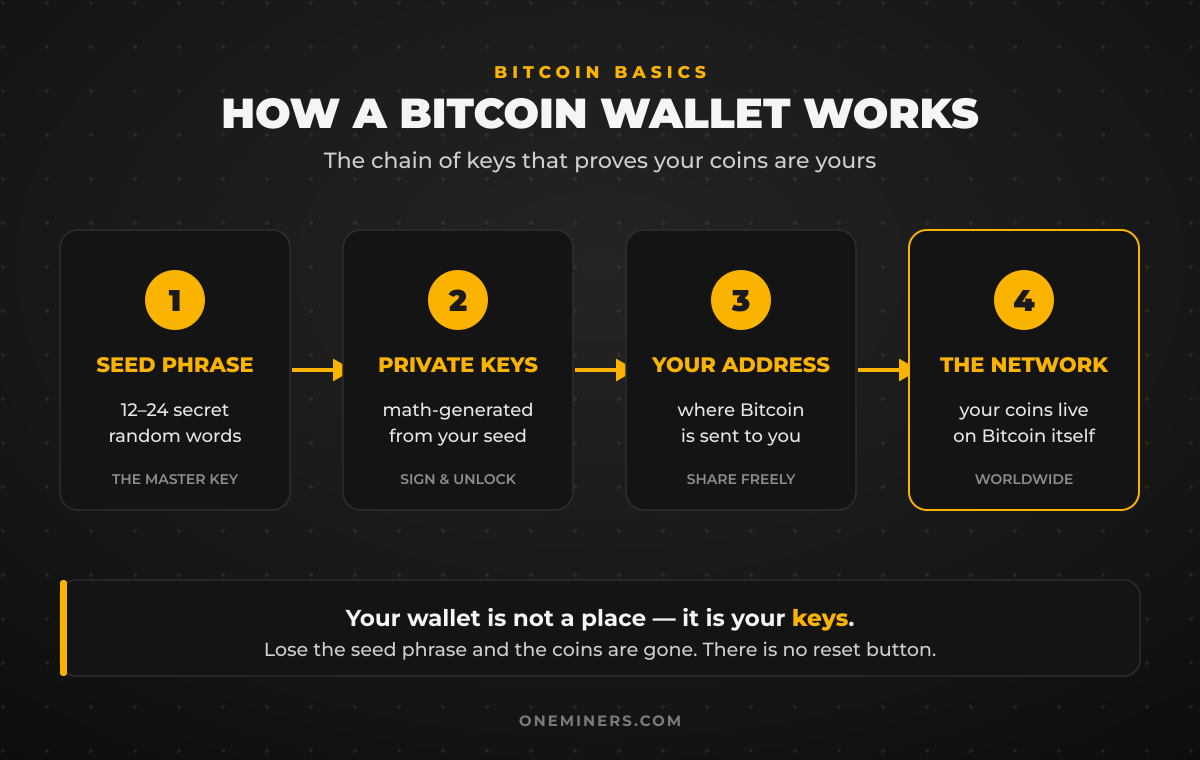
How a wallet actually works: your seed phrase is the master key behind everything else.
What Actually Went Wrong (In Plain English)
Think of your seed phrase like a combination lock with an enormous number of possible combinations. If the combination is truly random, a thief could guess for billions of years and never crack it. The maths is so lopsided that guessing is basically hopeless. That’s the magic that keeps Bitcoin safe.
Here is the problem. To create your words, the device needs to generate real, unpredictable randomness — the digital version of rolling a huge set of dice. On the affected device, a software bug meant the “dice” weren’t rolling properly. The words looked random to a human, but a computer could see a pattern — so instead of billions of years, the pool of possible combinations shrank to something a determined attacker could work through.
Once you can guess the words, the rest is easy for a criminal:
How the theft worked, step by step
- Step 1 — The bug made seed phrases far less random than advertised.
- Step 2 — Hackers wrote software to systematically guess the weakened phrases.
- Step 3 — Each correct guess handed them the keys to a real wallet.
- Step 4 — They moved the Bitcoin out — and because Bitcoin payments can’t be reversed, it was gone.
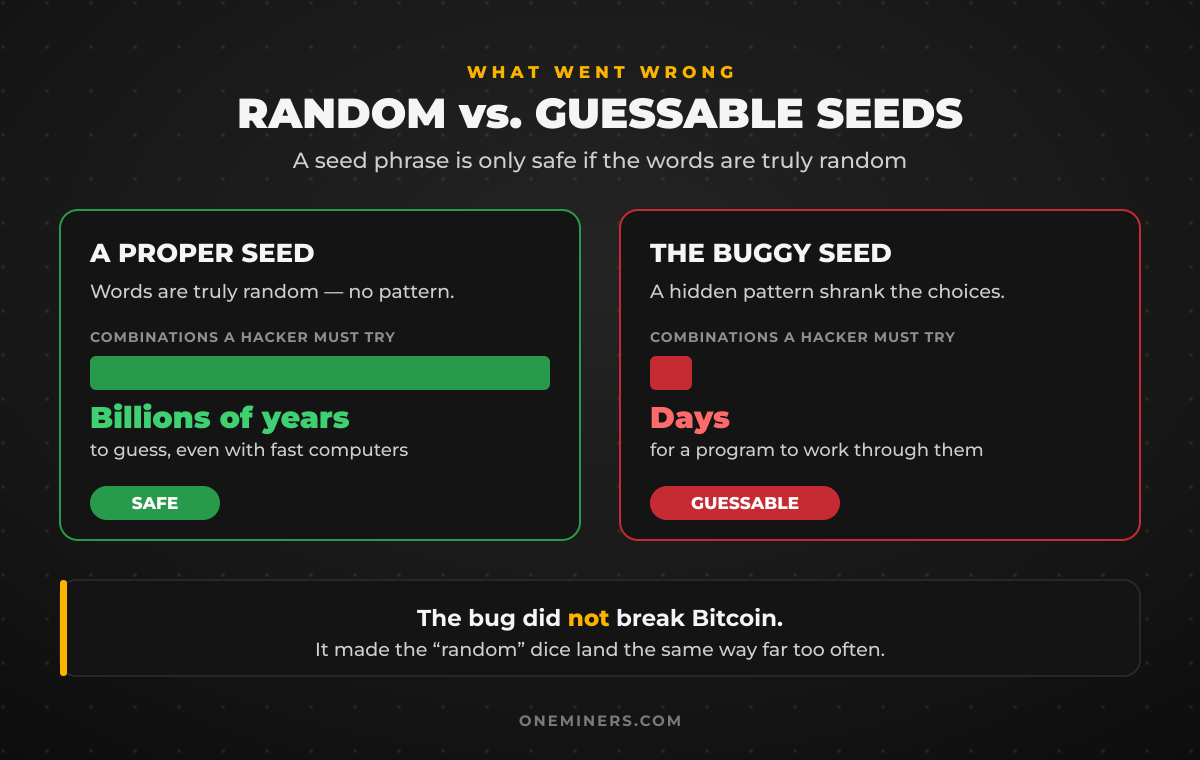
The bug shrank the guesses from astronomically huge to something a computer could crack.
Galaxy Research traced the bug all the way back to March 2021, which means some wallets were quietly vulnerable for years before anyone noticed. The thefts came in three big waves plus 14 smaller incidents, and researchers say the final total could climb toward 2,000 Bitcoin (around $130 million) once every victim is counted.
The Key Facts At A Glance
Here is the whole event boiled down to the numbers that matter, as reported by Galaxy Research and confirmed in part by device-maker Coinkite.
| The Question | The Answer |
|---|---|
| How much was stolen? | ~1,596 BTC (about $102 million), possibly up to ~2,000 BTC (~$130M) |
| How many people affected? | More than 7,300 wallets |
| What was the cause? | A software (“firmware”) bug that made secret seed phrases guessable |
| Which device? | A popular hardware wallet; the maker has confirmed the bug and shipped a fix |
| How far back? | The flaw dates to March 2021 |
| Who found it? | Crypto research firm Galaxy Research |
| Is Bitcoin itself broken? | No. The network worked normally; only one storage device was flawed |
Sources: reporting by Forbes (Ty Roush, Aug 2026), findings from Galaxy Research, and the security notice published by device-maker Coinkite.
Who Got Hit — And Why It Surprised Everyone
You might assume only beginners fell for this. Not so. According to Galaxy Research, roughly 600 of the drained wallets belonged to serious professionals — including federal investigators, compliance firms, and cyber-security investigators. These are exactly the people who are supposed to know best.
That is the real lesson here: this wasn’t a case of victims being careless or falling for a scam email. They did the “right” thing — they used a respected offline device — and were still exposed because of a flaw they had no way of seeing. Security is only ever as strong as its weakest hidden part.
“Wait — Is My Bitcoin Safe?”
For the vast majority of readers, the honest answer is yes, this specific problem does not affect you. It only involved one brand of hardware wallet, and only certain versions of its software. If you have never owned that device, this particular door was never open on your house.
But there is one important warning that applies even to owners who update their device: installing the fix does not repair a seed phrase that was already created with the bug. The maker, Coinkite, was clear about this. If your words were generated by the flawed software, they stay weak forever — the only real cure is to create a brand-new wallet (with fresh, properly-random words) and move your coins to it.
If you use the affected hardware wallet, do this
- Update the device to the latest software — but don’t stop there.
- Generate a completely new wallet with a fresh seed phrase on patched software.
- Move your Bitcoin from the old wallet to the new one.
- Retire the old seed phrase for good — never reuse it.
- Check the maker’s official security notice for the exact firmware versions involved.
5 Simple Ways To Keep Your Bitcoin Safe
You don’t need to be a tech expert to protect your coins. You just need a few good habits. Here are the five that matter most — in plain language.
1. Protect your seed phrase like it’s cash
Your 12 or 24 words are your money. Write them on paper (or stamp them into metal), store them somewhere private, and never type them into a website, an app, or a message. No real company will ever ask you for your full seed phrase. If someone does, it’s a scam — every single time.
2. Keep the majority of your coins offline
Money you’re actively trading can sit in an app; money you’re holding for the long run belongs offline, away from the internet. Spreading your coins across more than one place means no single failure — a bug, a lost phone, a phishing link — can wipe you out.
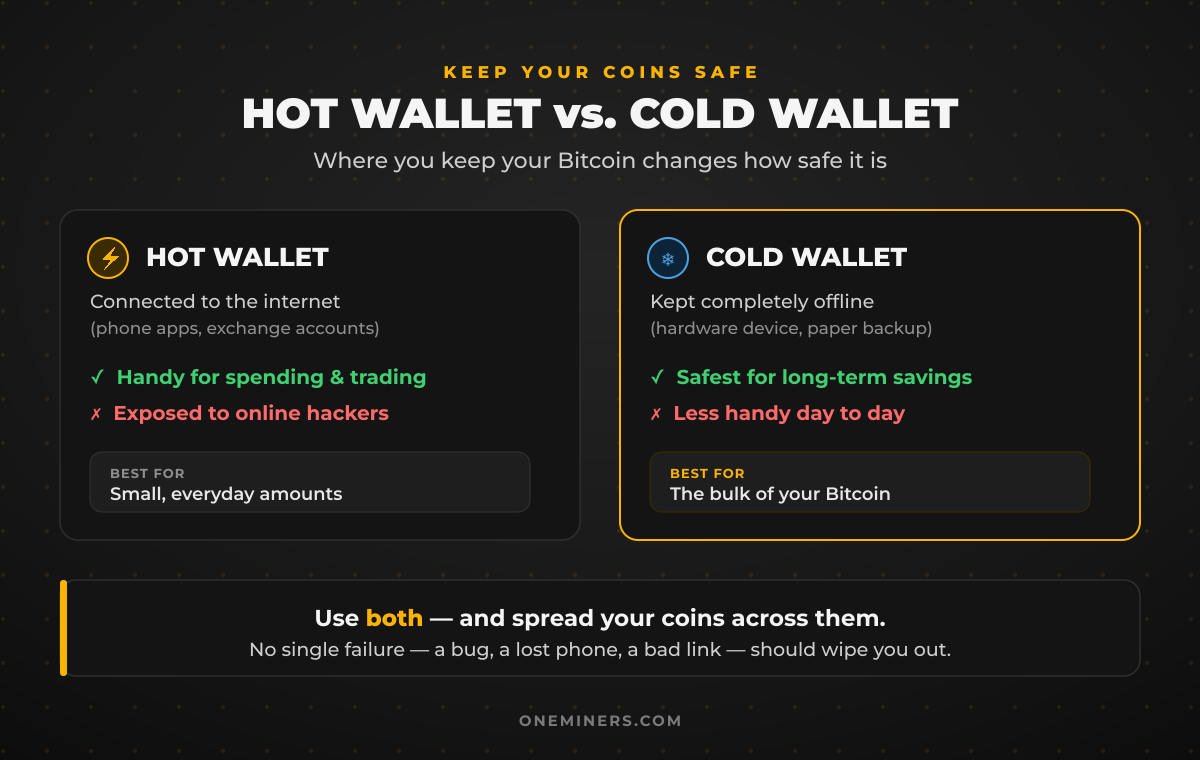
Hot vs cold storage: keep spending money online, keep your savings offline.
3. Keep your software updated
It sounds boring, but the fix for this very bug arrived as a software update. Updates are how companies close the holes that criminals look for. Turn them on, and install them promptly — only ever from the maker’s official website or app.
4. Double-check every address and every link
Most crypto losses aren’t master hacks — they’re fakes. A copycat website, a poisoned search result, a “support agent” in your DMs. Before you send anything, slow down, confirm the web address letter by letter, and never click a wallet link someone sent you out of the blue.
5. Use trusted, transparent partners
When you buy hardware, mine, or host, deal with established names that are open about who they are and how they operate. Transparency isn’t a marketing word — it’s the difference between a partner you can check up on and a black box you just have to hope about.
You can’t control every bug in the world. You can control how many places one bug could hurt you. That’s what these five habits are really for.
The OneMiners Angle: Earning Bitcoin You Actually Control
Stories like this one make people nervous about the whole idea of owning Bitcoin. We think that’s the wrong takeaway. The lesson isn’t “Bitcoin is dangerous” — it’s “the tools around Bitcoin need to be trustworthy and transparent.” That is exactly the standard we hold ourselves to at OneMiners.
OneMiners is a professional Bitcoin mining and hosting platform. In plain terms: instead of buying coins on an exchange, you can own a mining machine that produces Bitcoin for you, and we run it for you in one of our world-class facilities. Here is why that’s built around you staying in control:
Built for trust, not black boxes
- You keep custody. Payouts are sent to your wallet — the coins are yours to secure exactly the way this article describes.
- Real, checkable infrastructure. A global network of roughly 1,964 MW across multiple countries — real buildings, real machines, not vague promises.
- Honest, fixed economics. Hosting from as low as $0.0364/kWh in Nigeria on 7-year fixed electricity, with a 7-year hardware warranty and a 95%+ uptime guarantee.
- Money moves through the front door. Payments run over regular banking rails (ACH / SEPA / SWIFT) — no mystery middle-man holding your funds.
- See it for yourself. Track your machines in real time from the OneMiners iOS and Android app.
The point is simple: whether you buy Bitcoin or earn it by mining, the coins end up in your hands — and the habits in this guide are how you keep them there. If you’d like to run the numbers on earning Bitcoin instead of buying it, a calculator like asicprofit.com is a good sanity-check before you start.
Frequently Asked Questions
1. What is a hardware wallet, in one sentence?
It’s a small offline device that holds the secret keys to your Bitcoin, keeping them away from internet hackers — usually one of the safest ways to store coins.
2. What is a seed phrase?
It’s the list of 12 or 24 random words your wallet gives you when you set it up. Those words are your Bitcoin — anyone who has them controls your coins, so never share them.
3. What exactly was the bug?
The device wasn’t generating truly random words. The seed phrases followed a hidden pattern, which made them possible for hackers to guess and then drain the wallets.
4. Is my Bitcoin at risk if I don’t own that device?
No. This problem was limited to one brand of hardware wallet and certain versions of its software. If you never used it, this specific issue doesn’t touch you.
5. I use that wallet — what do I do right now?
Update the software, then create a brand-new wallet with a fresh seed phrase and move your coins to it. Updating alone is not enough — see the checklist above.
6. Does updating the firmware fix everything?
No. The update stops the bug going forward, but any seed phrase already made with the flaw stays weak. You must move your funds to a new, properly-generated wallet.
7. How do hackers “guess” a seed phrase?
Normally they can’t — the number of combinations is astronomically large. The bug shrank that number, so a computer program could work through the smaller pool and land on real phrases.
8. Does this mean Bitcoin itself is broken or unsafe?
Not at all. The Bitcoin network worked exactly as designed throughout. The weakness was in one storage gadget, not in Bitcoin.
9. Why did professionals get caught too?
Because the flaw was invisible from the outside. Even careful, experienced users had no way to know their “random” words weren’t random. It’s a reminder to spread risk across more than one tool.
10. How does OneMiners fit into keeping my Bitcoin safe?
OneMiners helps you earn Bitcoin through transparent, professionally-run mining and hosting, and pays out to a wallet you control. We handle the machines; you follow the five safety habits above to secure the coins.
Bitcoin isn’t the risk. Blind trust is. Choose transparent tools — and own your keys.


