


Antminer S23 Hydro: 580 TH/s at 9.5 J/TH — and What It Really Costs to Run
Bitmain's newest hydro miner is one of the most efficient Bitcoin machines you can buy. This is a plain-English look at its specs, its power use, whether it can be profitable, and the part the spec sheet leaves out: where you actually plug it in.
If you follow Bitcoin mining, you already know the pattern: every couple of years Bitmain releases a new Antminer that makes the last one look slow. The Antminer S23 Hydro is the newest one — and the number that matters this time isn't the speed. It's the efficiency: 9.5 joules per terahash, which finally slips under the 10 J/TH mark the industry has been chasing for years.
But here's the honest version most reviews skip. A faster, more efficient miner doesn't automatically make money. It just makes a bigger machine that needs power, cooling, and looking after — every hour, for years. So this article does two things: it tells you what the S23 Hydro is and what it costs to run, and it's straight with you about the thing that decides the outcome — not the miner, but the place you run it.
At a glanceAntminer S23 Hydro specs
Figures are Bitmain manufacturer specifications. OneMiners currently lists the 580 TH/s unit at an advertised $12,299 (down from a listed $15,000) — check the live price, as hardware pricing moves.
The hardwareWhat makes the S23 Hydro different?
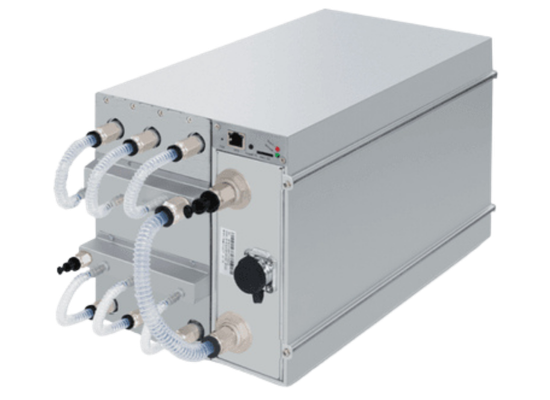
The S23 Hydro is a liquid-cooled, industrial-size Bitcoin miner. Instead of fans blowing hot air out the back, water runs through the machine and carries the heat away. That's what "hydro" means here — and it's why the S23 can run this hard while staying quiet (around 50 dB, roughly office-loud rather than jet-engine-loud).
One quick note on timing: when this machine was first written about in 2025, its specs were still a promise. In 2026 they're real — it's listed, priced, and shipping through distributors and hosts, OneMiners included. Bitmain also sells a denser "3U" version that roughly doubles the numbers in one box (about 1,160 TH/s and 11 kW).

Plain EnglishWhat 9.5 J/TH actually means
You'll see "J/TH" everywhere in mining, so here it is in one line:
Dropping under 10 J/TH is a real milestone, because power — not the sticker price of the machine — is what usually decides whether a mining setup survives a rough market. A more efficient miner does the same work for a smaller electricity bill. Look at how quickly that number has fallen over one decade of Antminers:
Antminer efficiency by generation (J/TH — lower is better)
The S23 Hydro uses roughly a tenth of the power-per-terahash of a 2016 flagship.
| Miner | Year | Hashrate | Power | Efficiency |
|---|---|---|---|---|
| Antminer S9 | 2016 | ~13.5 TH/s | ~1,350 W | ~100 J/TH |
| Antminer S19 XP | 2022 | 140 TH/s | 3,010 W | 21.5 J/TH |
| Antminer S21 XP Hydro | 2025 | 473 TH/s | 5,676 W | 12 J/TH |
| Antminer S23 Hydro | 2026 | 580 TH/s | 5,510 W | 9.5 J/TH |
Put the top and bottom rows side by side: the S23 does about 43 times the work of the 2016 S9 for roughly 4 times the power. That's why old miners quietly stop being worth running long before they actually break.
Head to headAntminer S23 Hydro vs S21 XP Hydro
The fairest comparison is against the machine it replaces — last year's hydro flagship, the S21 XP Hydro. The S23 does more work, for slightly less power:
| Spec | S21 XP Hydro (2025) | S23 Hydro (2026) |
|---|---|---|
| Hashrate | 473 TH/s | 580 TH/s |
| Power | 5,676 W | 5,510 W |
| Efficiency | 12 J/TH | 9.5 J/TH |
| Cooling | Hydro | Hydro |
In plain terms: about 23% more hashrate while drawing a touch less power, which works out to roughly 21% better efficiency. If you're already running S21 Hydro machines, the S23 is a genuine step up rather than a rebadge — though whether it's worth upgrading depends on your power price and how long your current gear has left.
Running costsAntminer S23 Hydro power consumption
Efficiency is the headline; the raw power draw is the reality you pay for. At 5,510 W (5.51 kW) running around the clock, here's how much electricity one S23 Hydro gets through:
| Period | Electricity used |
|---|---|
| Per hour | 5.51 kWh |
| Per day | ~132 kWh |
| Per 30-day month | ~3,967 kWh |
| Per year | ~48,268 kWh |
That's the number that turns into a bill — and the size of that bill depends entirely on your electricity rate, which brings us to the question everyone actually wants answered.
The real questionIs the Antminer S23 Hydro profitable in 2026?
Honest answer: it depends, and anyone who gives you a flat "yes" is selling something. Mining isn't one number — it's a subtraction problem:
The revenue side is out of your hands. It rises and falls with Bitcoin's price, the network's difficulty, transaction fees, and "hashprice" — basically what one unit of mining power earns per day, which changes constantly. Because those move all the time, this article won't quote a daily profit figure; any number printed today could be wrong next week. For a live estimate, plug the S23's specs into a current mining calculator and use your own power rate.
What you can control is the cost side — and that's where the S23 Hydro earns its keep. Its low 9.5 J/TH efficiency shrinks the biggest running cost, electricity. Here's the annual power bill for one machine at a range of rates:
Annual electricity cost — one S23 Hydro (~48,268 kWh/yr)
Same machine, same work. The only thing that changes is your electricity rate.
Read that chart and the whole game becomes obvious. The same miner costs about $2,317 a year to power at $0.048/kWh but $4,827 at $0.10/kWh — a difference of around $2,510 per machine, every year, before it earns a single satoshi. So "is it profitable?" really means "is it profitable where you plan to run it?" A great miner on expensive, unreliable power can lose to an average miner on cheap, steady power.
ScaleOne machine is easy. A thousand isn't.
A single S23 pulling 5.51 kW is manageable — it's about the load of a couple of ovens running non-stop. The trouble starts when you think like an actual operation:
| Fleet | Hashrate | Miner power load* | Electricity / year |
|---|---|---|---|
| 1 miner | 580 TH/s | 5.51 kW | ~48,268 kWh |
| 100 miners | 58 PH/s | 551 kW | ~4.83 million kWh |
| 1,000 miners | 580 PH/s | 5.51 MW | ~48.3 million kWh |
| 10,000 miners | 5.8 EH/s | 55.1 MW | ~482.7 million kWh |
*Miner load only — cooling and facility overhead add more on top.
A thousand of these is 5.51 megawatts running non-stop — a small substation's worth of power. That's the key idea worth remembering: the S23 Hydro story is a data-center story wearing a hardware headline. At any real size you're not buying a gadget, you're running infrastructure — power contracts, transformers, water cooling, networking, security, and people to fix things.
LocationWhy where you mine can matter as much as the miner
Take that yearly gap — roughly $2,510 per machine between cheap and expensive power — and multiply it. Across 1,000 miners, moving from a $0.10 site to a $0.048 site saves on the order of $2.5 million a year in electricity, for the exact same hardware doing the exact same work. Nothing about the miner changed. Only the plug did.
This is the real reason large miners obsess over location: cheap, stable power is the single biggest lever on the cost side. But cheap power in a place with frequent outages or no one to fix a broken machine can quietly cost more than a slightly higher rate somewhere dependable. Which leads to the two things a hydro miner needs that a spec sheet never mentions — a proper home, and someone to run it.
The catchHydro cooling is great — and hard to run yourself
The same water-cooling that makes the S23 so efficient is also what makes it a handful. A hydro miner isn't a plug-and-play box for a spare room. It needs a closed water loop: pumps, heat exchangers, plumbing, leak detection, coolant that's kept clean, and someone who actually knows how to maintain all of it.

So the better the hardware gets, the more it rewards having a professional operation behind it — not less. For most people, running a fleet of hydro miners at home simply isn't realistic. That's the gap managed hosting is built to fill.
The practical fixWhere managed hosting — and OneMiners — comes in
Managed hosting is straightforward: instead of buying a miner and then hunting for cheap power, a place to put it, and a technician to fix it, you choose the hardware and a location, and the host handles power, cooling, monitoring and repairs. You watch it remotely. For a hydro machine, that removes exactly the headaches from the last section.
OneMiners is one company built around this model, which is why it's a useful real-world example here. It sells the S23 Hydro and also offers hosting for it, so the miner can be deployed at one of its sites rather than shipped to your door. According to the company, its network spans roughly 21 locations across five continents and about 2,060 MW of capacity, with advertised electricity from around $0.048/kWh at its lowest-cost sites and an uptime target in the region of 97–99%. Those are company-reported figures — sensible to verify against current listings rather than take as independently audited fact — but they line up with the two things that actually matter for a hydro fleet: low power cost and steady running.
A few practical pieces round it out, again as described by the company: onsite technicians and spare parts so a failed pump or board doesn't leave a machine dark for weeks; a customer app to monitor your miners; a "Pay Later" option that starts at roughly 25% upfront to spread the hardware cost; and "AI Smart Mining" software the company says can improve results (its cited range is wide and hasn't been independently tested, so treat it as a claim, not a promise). The reason to consider a host like this isn't a slogan — it's that hydro miners are genuinely hard to run alone, and someone else absorbing the power, cooling and maintenance is a real, concrete benefit. Worth a look at the current S23 Hydro price and hosting options and rates before deciding either way.
Keeping it honestWhat could go wrong
Efficient hardware and good hosting don't cancel the real risks. Before spending money, keep the whole picture in view:
- Market swings — Bitcoin's price, rising difficulty and a falling hashprice can shrink margins fast.
- Rules & trade — regulation, tariffs and import limits can change the maths overnight.
- Energy — power prices and contract terms can move; today's cheap rate may not last.
- Execution — facility delays, the gap between "announced" and "running" capacity, and trusting any single host.
- Hardware — parts fail, and hydro cooling adds more things that can leak or stop.
- Location — very cheap power often comes with country-specific risk.
- Company-reported data — a lot of capacity and performance numbers come from the companies themselves; verify what you can.
- Getting old — the same fast progress that made the S23 possible will one day make it yesterday's miner.
None of this means mining is a bad idea. It means it's a real business, and even the most efficient machine on earth doesn't guarantee a profit.
Bottom lineThe S23 Hydro is impressive — the plug is the decider
The Antminer S23 Hydro earns its reputation. Slipping under 10 J/TH at 580 TH/s is a real leap, and if you're upgrading from older gear the efficiency gain is hard to argue with. But the spec sheet is only the start of the story.
Whether one of these actually pays off comes down to the boring, powerful stuff: your electricity rate, your uptime, your cooling, your maintenance — in a word, your infrastructure. Bitmain pushed the hardware below the 10 J/TH line. The question that follows you home is simpler: where can this machine run cheaply, reliably, and without you babysitting it? Answer that well and the S23 Hydro is a serious tool. Answer it badly and even the best miner in the world can disappoint.
See the Antminer S23 Hydro on OneMiners
Current price, specs and hosting options for the 580 TH/s hydro miner — scan the code or tap through.
View the S23 Hydro → Scan for the
S23 Hydro listing


