


Crypto Proof of Holdings Certificate
Documented blockchain evidence of what a wallet holds, how long it has held it, and that the wallet belongs to you. Issued as a signed, stamped certificate your bank, accountant or tax adviser can put on file.
From $150, tax included. Verification periods of one, two, three or more years. Issued by CircleHash LLC d/b/a OneMiners, Austin, Texas.
A public ledger is not a document
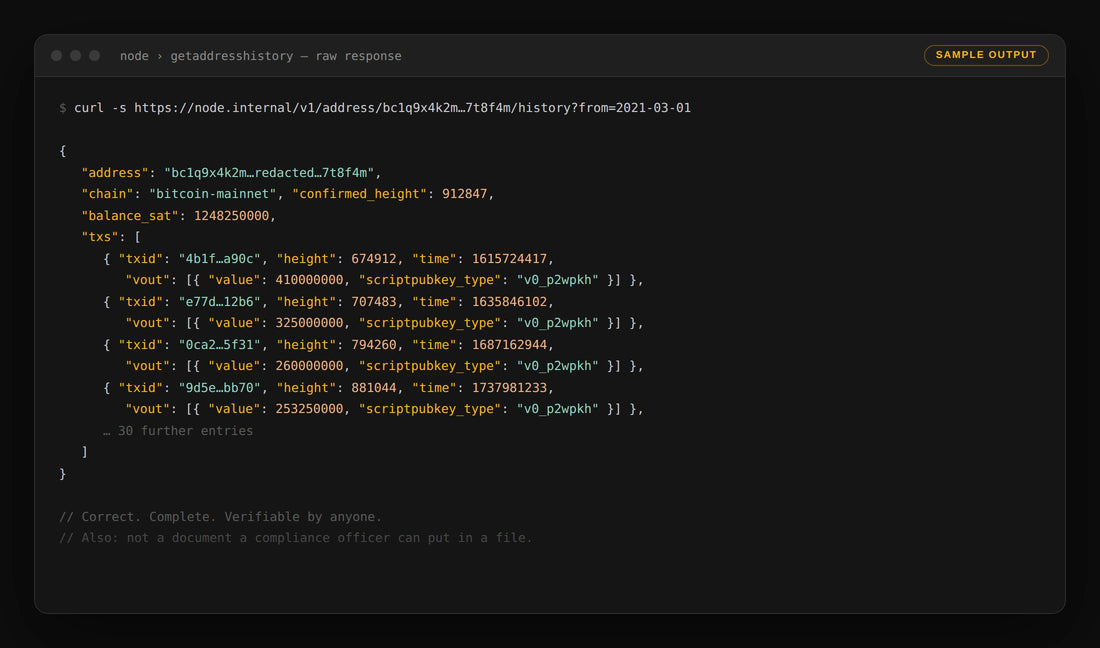
A blockchain is public, but it is not self-explanatory. When a bank, an accountant or a tax authority asks you to evidence a crypto position, sending a link to a block explorer rarely ends the conversation. They want a document: what the address holds, when the assets arrived, over what period, and on what basis anyone should believe the address is yours.
That is what this certificate is. We examine the public blockchain record for the address you specify, document exactly what it shows, and issue it as a formal verification certificate with a unique reference number the recipient can check with us.
People often search for this as a crypto proof of funds letter. We avoid that term as a product name on purpose. It carries a long association with property and escrow fraud, and a document titled that way starts at a disadvantage in front of a compliance officer. What you actually need is evidence of holdings, holding period and control.
OneMiners has spent years building, hosting and running blockchain infrastructure. Reading a chain properly is not a side business for us.
Who asks for this, and why
People arrive here with different problems. Find yours — each one has a different answer about what the certificate can and cannot settle.
Your bank is asking where the money came from
Mortgages, business loans, large deposits and account onboarding all trigger source-of-funds questions — and if the wealth sits on a blockchain, the bank's usual evidence does not exist. The certificate puts the address, the balance, the incoming transactions and the period on one page.
Your accountant needs the crypto on the balance sheet
Digital assets have to be evidenced at period end like any other asset: the balance at a date, the movements during the period, and identifiers to trace them. Every hash and block number in the certificate resolves on a public explorer, so nothing has to be taken on trust.
You need to evidence how long you have held
Holding period changes the tax treatment in many countries. As the rules stand in September 2026, the United States applies long-term capital gains rates to assets held more than one year rather than ordinary income rates. That is why the periods offered are one, two, three and three-plus years.
An exchange is asking you to prove ownership
Compliance teams increasingly ask users to evidence the origin of deposited assets, or to show that an external wallet is under their control before releasing a withdrawal. A certificate with a proof-of-control block answers both halves of that request in one document.
A court or an executor needs the numbers
Divorce settlements, probate and insolvency all require assets to be enumerated, and crypto is usually the item nobody can pin down. The certificate fixes the position at a date, with references any party can verify independently — which tends to shorten the argument.
Your wealth manager is onboarding you
Private banks building a picture of your total position need crypto documented in a form that fits a client file: a dated, referenced record with a verification number they can check — rather than a screenshot of an app.
What the document actually looks like
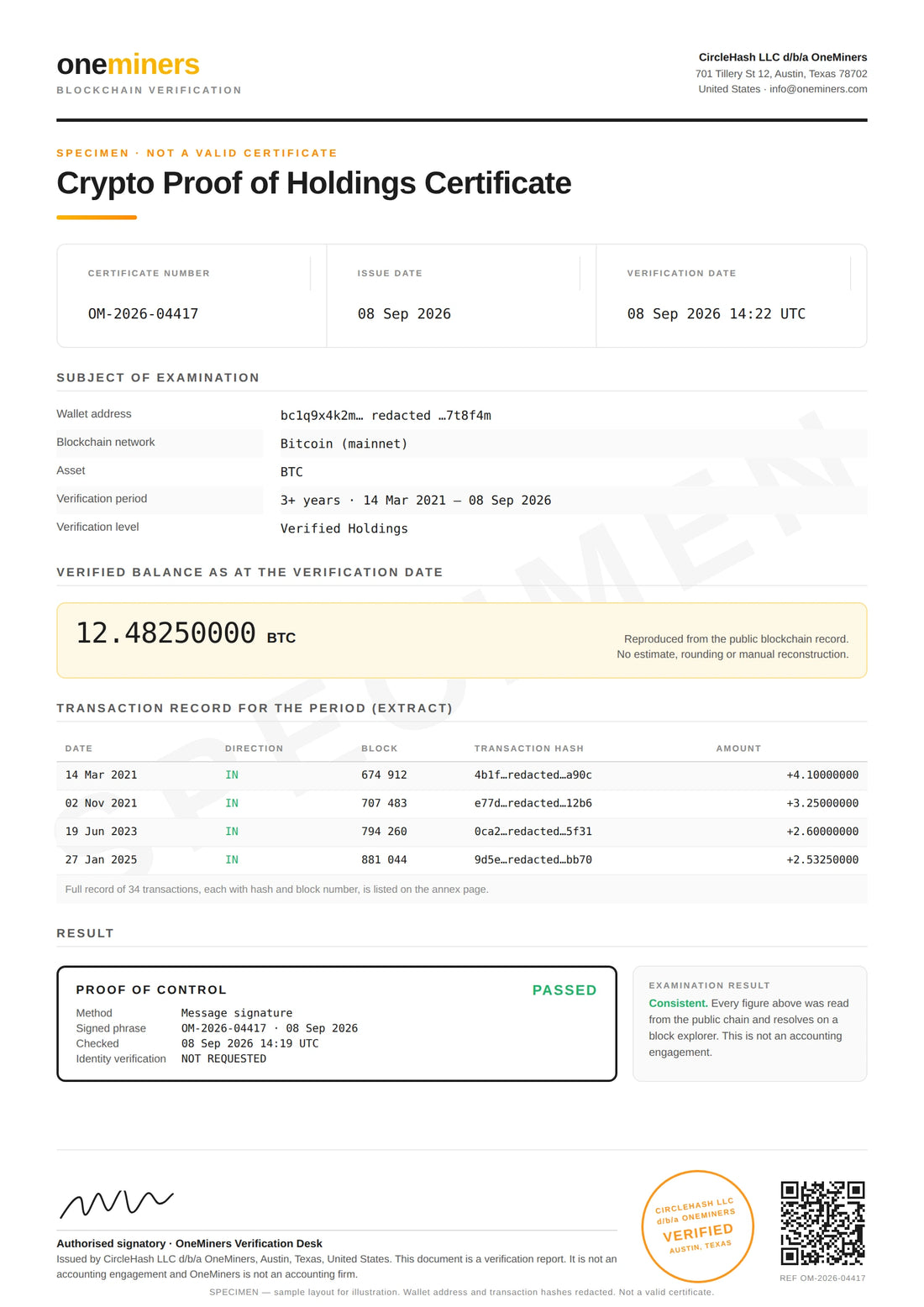
One page, plainly laid out, with nothing on it that cannot be checked against the public chain. The recipient does not have to take our word for anything — every hash and block reference in it resolves on a block explorer.
- Certificate number, issue date and verification date
- Wallet address, network and asset
- Verified balance as at the verification date
- Transaction history for the requested period, with hashes and block numbers
- Proof of control result and the method used
- Signature, company stamp and QR verification reference
What is examined, and what you receive
Every figure in the certificate is reproduced from the blockchain record and can be checked independently by whoever receives it.
What we examine
Read from the public chain, for the address and period you specify.
- Wallet address and blockchain network
- Cryptocurrency and asset type
- Verified balance as at the verification date
- Incoming and outgoing transactions across the period
- Transaction dates and blockchain timestamps
- Block numbers and transaction hashes
- Amounts transferred
- Transfers between addresses you identify as yours
- Historical acquisition transactions in the period
- Continuity of the assets, where the chain makes it determinable
What the certificate contains
A signed, stamped PDF with a reference the recipient can check.
- Unique certificate number
- Issue date, verification date and time
- Wallet address, blockchain and asset
- Verified balance
- Transaction detail for the requested period
- Transaction hashes and block references
- Proof of control result — PASSED or NOT REQUESTED
- Technical examination result
- Authorised signature and company stamp
- Verification reference and QR code for the recipient to check
Networks we examine
If your chain is not on this list, ask before you order. We will tell you honestly whether we can examine it properly.
Proof of control — the part most services skip
A blockchain address is public. Anyone can look up a large wallet and read its balance. Which means a document that only states a balance proves nothing about whose balance it is — and a compliance officer who has seen a few of these knows it.
Message signing
We give you a phrase containing your certificate number. You sign it with the key that controls the address — signmessage in Electrum, Sparrow or a hardware wallet for Bitcoin, personal_sign in a browser wallet for EVM chains. We check the signature against the address. The key never leaves your device, it is free, it is instant, and it leaves no trace on the chain. We offer this first.
Micro-transaction
Where signing is impractical, you send an exact amount we specify, to an address we specify, inside a window we specify. The amount is unique to your verification and time-boxed, so no earlier payment can satisfy it. It must be sent from the wallet itself and not from an exchange — otherwise the sender on the chain is the exchange, and the proof fails.
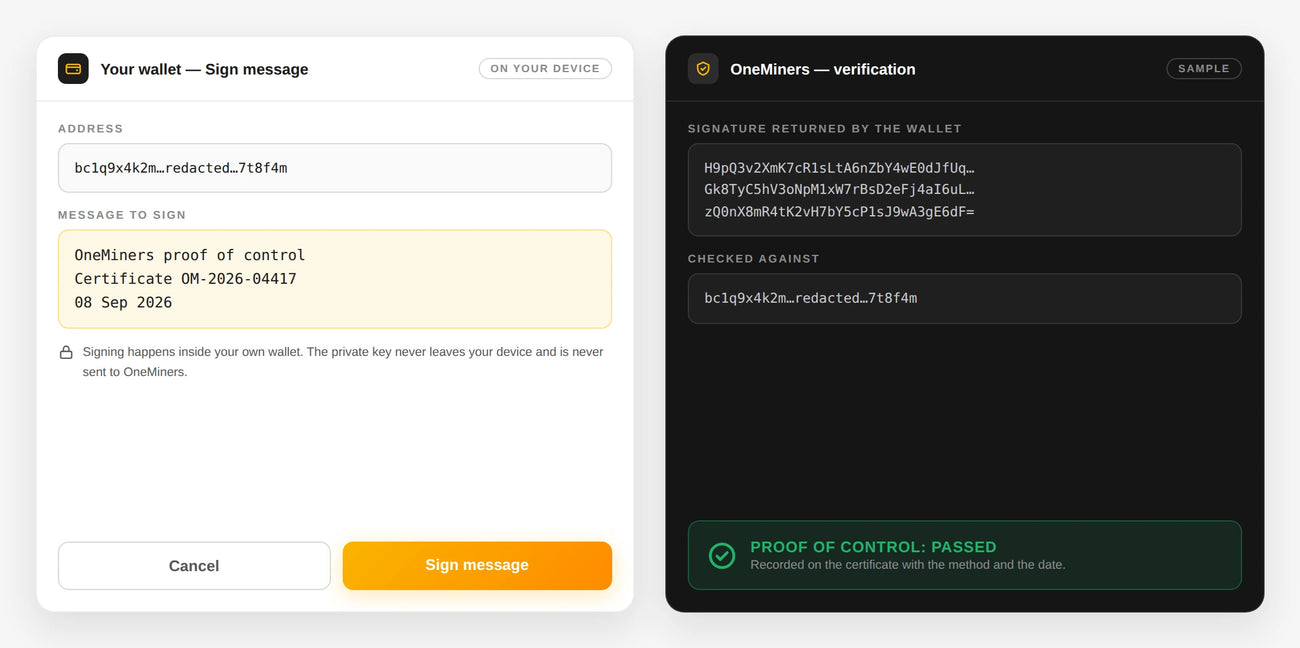
The result is stated on the certificate as its own block. A certificate reading PROOF OF CONTROL: PASSED is a materially stronger document in front of a bank, and it is the reason ours are worth presenting at all.
Three levels
Every level produces the same document. What changes is how much of it the recipient has to take on trust: the address alone, the address and your control of it, or that plus who you are.
For your own records, your bookkeeper or your accountant — where whose wallet it is has already been settled between you.
- One wallet address, one network
- Verification period of 1, 2, 3 or 3+ years
- Full transaction history, hashes and block references
- Verified balance as at the verification date
- Signed, stamped certificate with QR verification
- Certificate states PROOF OF CONTROL: NOT REQUESTED
For anything leaving your desk — a bank, an exchange, an accountant, a court or a tax authority.
- Everything in Address Verification
- Proof of control by signature or micro-transaction, recorded as PASSED
- Up to 3 addresses on one certificate
- Priority handling
- Free re-issue with an updated balance within 12 months
For the strongest case a document can make — where the recipient needs to know that the person named is the person controlling the wallet.
- Everything in Verified Holdings
- Identity documents examined against the originals
- Live video call matching the document to the person
- Certificate records IDENTITY VERIFICATION: PASSED, with method and date
- Scans and recording deleted after 30 days — only the record of the check is kept
Prices are final and include tax. If a verification cannot be completed, you are refunded in full.
How it works
Five steps. Nothing is charged until we have confirmed we can examine what you need.
You tell us what you need
The network, the asset and the period. No account access, no keys, no exchange logins. We reply within one business day and say no when the answer is no.
You order and give us the address
Choose the level and the period. The wallet address is only needed at this point, not in the first enquiry.
You prove control
On Verified Holdings and above we send a phrase to sign, or the amount and window for a micro-transaction. Two minutes in your own wallet.
We examine the chain
Balance, transaction history, hashes, block references, and traceability to the current balance where the chain supports it. Two to three business days from the point we have the address and your completed control check.
You receive the certificate
A signed, stamped PDF with a unique number. Recipients scan the QR code or quote the reference to confirm it is genuine, without going through you.
What this certificate does not do
We would rather you knew this before you paid than after your bank asked.
Get the position documented
Tell us the network, the asset and the period you need covered. If the certificate is going to a bank, an exchange or an accountant, choose Verified Holdings — the proof-of-control block is what makes the document worth presenting. Nothing is charged until we have confirmed we can do it.
Start a verification
