


ONEMINERS - HOME MINING, CHECKED
Can You Still Mine Bitcoin at Home in 2026?
You can plug one in. Whether it earns anything is a different question, and at a normal household electricity rate the answer is no. Here is the arithmetic, the wiring and the noise.
Power price, wiring, noise and heat. Four practical reasons, all measurable.
The Bitcoin network is running at about 950 EH/s, difficulty sits at 132.76 trillion at block height 967,975, and the next retarget is pointing down 2.0 percent. With Bitcoin near $84,834, hashprice works out at roughly $40.54 per petahash per day. Difficulty and height are from the live chain, price from blockchain.info, the retarget estimate from mempool. Those are the only four inputs anyone needs.
Home mining is the question almost everyone starts with, and it deserves a straight answer rather than either the hype or the sneering. The short version: you can absolutely run a Bitcoin miner in a house. Four separate things then get in the way, and only one of them is about Bitcoin.
They are the electricity price, the electrical supply the machine actually needs, the noise, and the heat. Each one is measurable, so none of it has to be argued about.
Key takeaways
Reason one: the power price, which settles it on its own
Electricity is 75 to 85 percent of the ongoing cost of running an ASIC. Rack space, technicians, cooling maintenance, insurance and monitoring are rounding errors next to it. That is why almost every honest question about mining collapses into one question about your power bill.
Every ASIC has a break-even electricity price, calculated from its efficiency in joules per terahash:
break-even dollars per kWh = hashprice / (24 x J/TH)
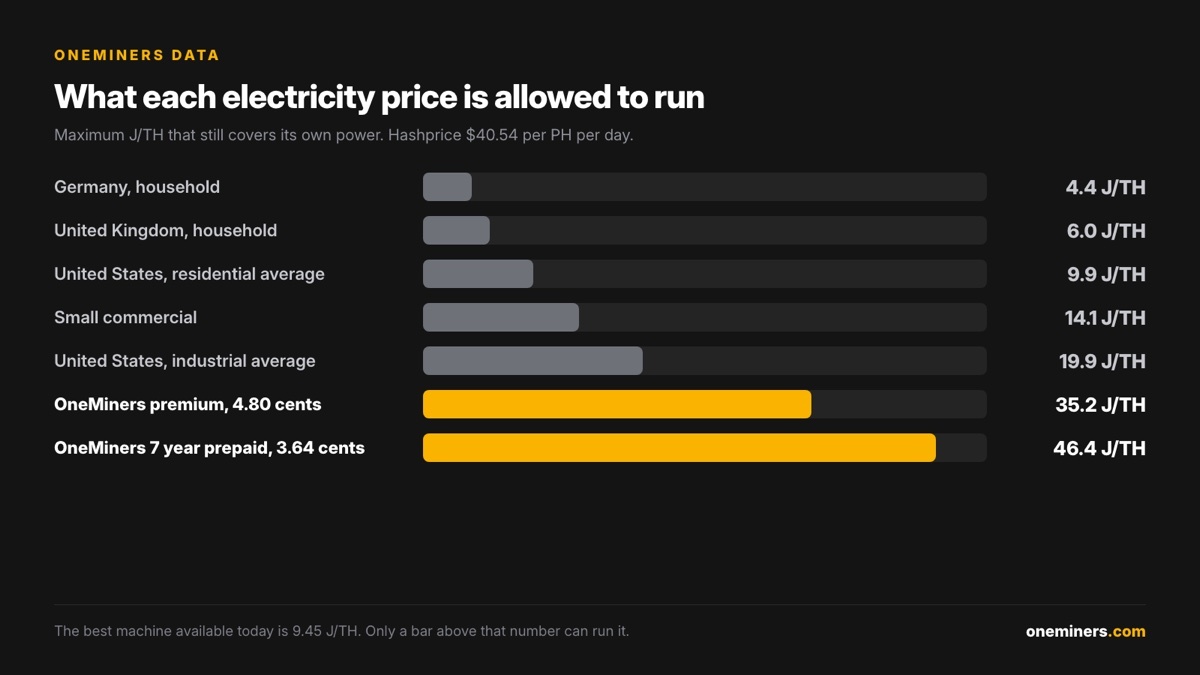
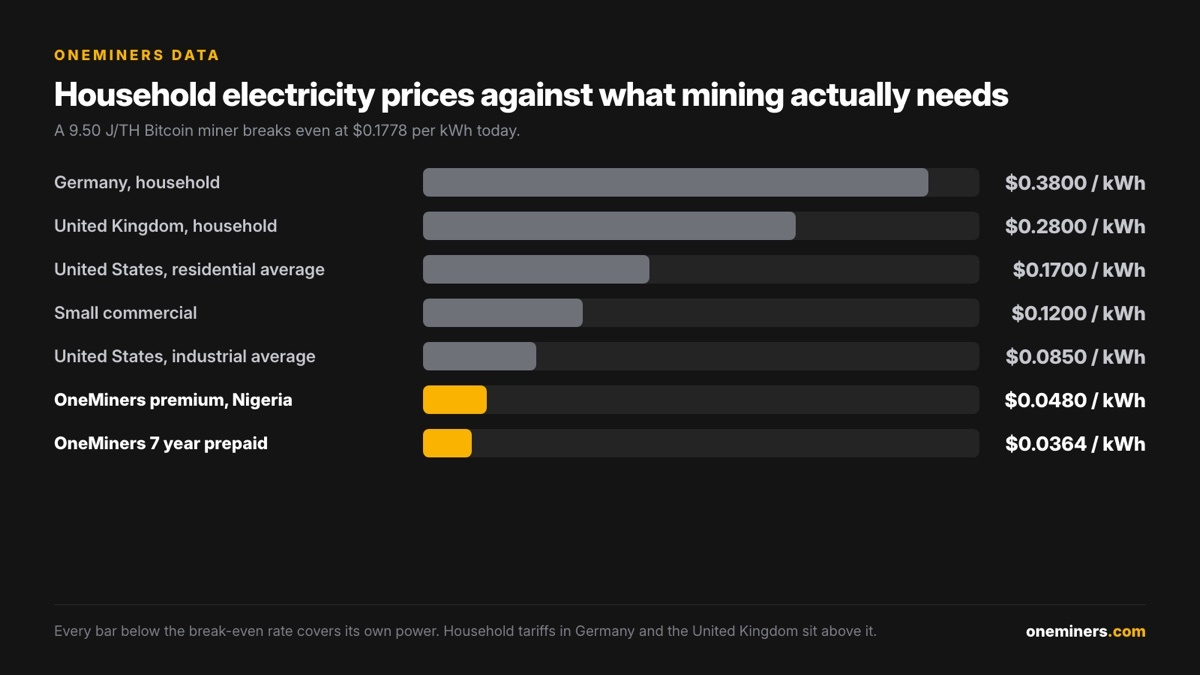
Turn that around and it tells you what a given tariff is allowed to run. At $40.54 per petahash per day, a 17 cent household rate can only support a machine of 9.9 J/TH or better. Nothing on the market reaches that. The most efficient unit in the catalogue is 9.45 J/TH, which is a very good machine and still roughly twice as thirsty as a household tariff can carry.
What each electricity price is allowed to run
Higher is better. Hashprice $40.54 per PH per day, 21 September 2026.
Scale: maximum J/TH that still covers its own electricity
For reference, the best machine available today is 9.45 J/TH and the entry unit is 17.50 J/TH. Only the bars above those figures can run them.
That chart is the entire home mining debate in one picture. A household tariff tops out around 9.9 J/TH. A hosted industrial rate tops out around 35.2 J/TH. Every machine ever made fits under the second ceiling and none fit under the first.
Reason two: the supply most machines need does not exist in a house
This one surprises people, and it is not an opinion. The specifications below come from the live product pages. Most high-end Bitcoin miners are three-phase industrial equipment. A standard home has single-phase power at 110 to 240 volts, and a normal socket circuit cannot carry a machine of this size even when the voltage matches.
| Bitcoin miner | Power draw | Supply required | Noise and cooling | Heat output | Break-even rate |
|---|---|---|---|---|---|
 Antminer S23 Hyd 3U Antminer S23 Hyd 3U |
11,020 W | 380 to 415 V, three phase | 50 dB, hydro | 37,600 BTU/hr | $0.178/kWh |
 Sealminer A4 Ultra Hyd Sealminer A4 Ultra Hyd |
8,372 W | 380 to 415 V, three phase | 50 dB, hydro | 28,565 BTU/hr | $0.179/kWh |
 Antminer S23e Hyd 2U Antminer S23e Hyd 2U |
8,650 W | 380 to 415 V, three phase | 50 dB, hydro | 29,514 BTU/hr | $0.169/kWh |
 Antminer S23 Hyd Antminer S23 Hyd |
5,510 W | 380 to 415 V, three phase | 50 dB, hydro | 18,800 BTU/hr | $0.178/kWh |
 WhatsMiner M73S WhatsMiner M73S |
7,560 W | 380 to 415 V, three phase | 75 dB, air | 25,795 BTU/hr | $0.125/kWh |
 Antminer S21 XP Hyd Antminer S21 XP Hyd |
5,676 W | 220 to 240 V | 50 dB, hydro | 19,367 BTU/hr | $0.141/kWh |
 Antminer S21 Antminer S21 |
3,290 W | 110 to 240 V | 75 dB, air | 11,225 BTU/hr | $0.097/kWh |
Supply, voltage and noise figures are published on each OneMiners product page. Heat is the machine's wattage converted at 3.412 BTU per watt hour, because an ASIC turns very nearly all of its electricity into heat.
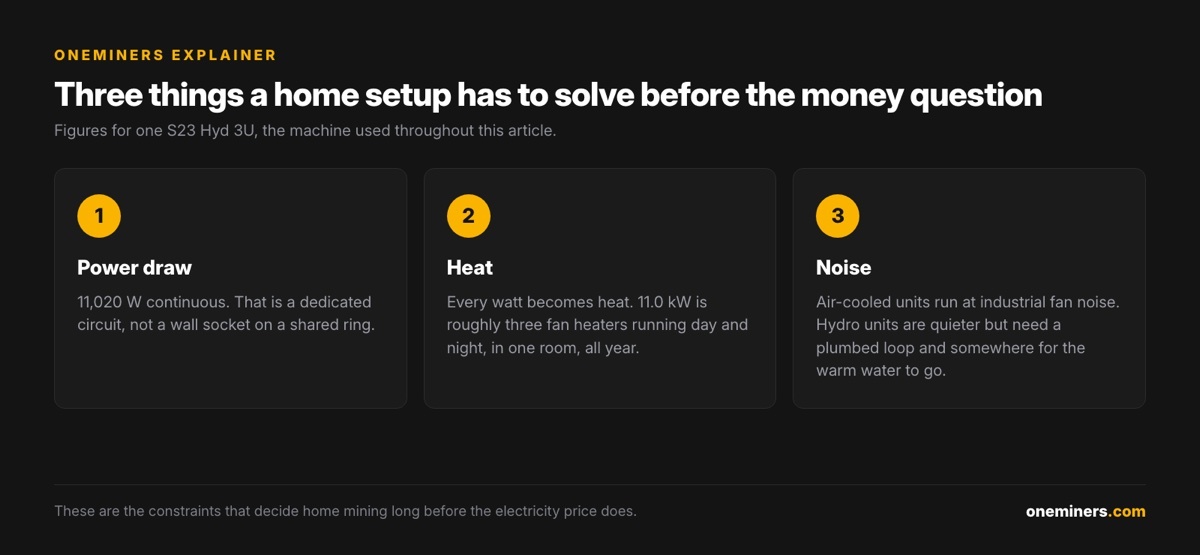
Take the entry level Antminer S21, the one unit here that will accept household voltage. It draws 3,290 watts. On a 240 volt circuit that is about 13.7 amps, so it needs its own dedicated circuit of the kind a clothes dryer uses. On a 120 volt circuit it would pull about 27 amps, which is more than a standard household socket circuit is rated to deliver at all. The machine is not the hard part. The wiring is.
Reason three: the noise is not negotiable
Air-cooled Bitcoin miners are published at 75 dB. That is the sound of a vacuum cleaner, continuously, for years. It is not a fan hum you stop noticing. People try garages, sheds and basements, and the honest experience is that a 75 dB machine is audible through a wall and through a floor.
Hydro-cooled units are published at 50 dB, which is genuinely quieter, but they solve the noise by moving the heat into water, which means a coolant loop and somewhere to reject that heat. That is a plumbing project, not an appliance, and the hydro units are also the ones asking for three-phase power.
Reason four: the heat has to go somewhere
An ASIC converts essentially all of its electricity into heat. One Antminer S21 at 3,290 watts is about 11,225 BTU per hour, which is comparable to two or three electric space heaters running permanently. A Antminer S23 Hyd at 5,510 watts is roughly 18,800 BTU per hour. In winter in a cold climate that is a genuine bonus. In summer, or in a warm country, you end up paying to make the heat and then paying again to remove it.

So what do people actually do instead?
They buy the machine and put it somewhere the electricity is cheap and the building is designed for it. That is all hosting is. You own the hardware, it sits in a facility built for three-phase power and industrial cooling, and you pay a published rate per kilowatt hour instead of a household tariff. At 4.80 cents per kilowatt hour, or 3.64 cents on a seven year prepaid contract at the Nigeria hosting center, the same machine that loses at home clears its power cost comfortably.
The difference on one Antminer S23 Hyd is $16.13 a day in electricity, which is $5,889 over a year. The noise, the heat and the wiring stop being your problem at the same time.
Antminer S21$1,111Hashrate188 TH/sEfficiency17.50 J/THPower draw3,290 WBreaks even at$0.097/kWhPower at 4.80 cents$3.79/dayView listing
Antminer S21 XP Hyd$6,199Hashrate473 TH/sEfficiency12.00 J/THPower draw5,676 WBreaks even at$0.141/kWhPower at 4.80 cents$6.54/dayView listing
Antminer S23 Hyd$12,299Hashrate580 TH/sEfficiency9.50 J/THPower draw5,510 WBreaks even at$0.178/kWhPower at 4.80 cents$6.35/dayView listing
From an entry unit that will run on household voltage to the hydro machines that will not.
When home mining does make sense
Final thoughts
You can still mine Bitcoin at home in 2026. What you cannot do at an ordinary household electricity rate is mine it for less than it is worth. At 17 cents the electricity alone for one Bitcoin comes to about $81,113, and at a German household rate about $181,311 against a $84,834 coin. Three-phase supply, 75 dB and several thousand BTU an hour are the practical reasons people stop. The power price is the reason they should never have started. Hardware is a purchase. Electricity is the business.
Skip the wiring and the noise: compare published hosting rates, then choose the Bitcoin miner to put on them.
Compare hosting locationsBrowse the miner catalogueFrequently asked questions
Can you still mine Bitcoin at home in 2026?
Physically yes, profitably almost never. At an average United States residential rate of 17 cents per kilowatt hour, a machine would need to be under 9.9 J/TH to cover its own electricity, and the best machine available is 9.45 J/TH.
What electricity rate do I need to mine at home?
Below your machine's break-even rate. For today's most efficient units that is roughly $0.179 per kilowatt hour, which is an industrial price rather than a household one.
How loud is a Bitcoin miner?
Air-cooled units are published at 75 dB, similar to a vacuum cleaner running continuously. Hydro-cooled units are published at 50 dB but require a coolant loop and, in most cases, a three-phase supply.
Can I plug a Bitcoin miner into a normal socket?
Usually not. Most high-end units need 380 to 415 volt three-phase power. Even an entry unit at 3,290 watts pulls about 13.7 amps at 240 volts and needs its own dedicated circuit.
How much heat does a Bitcoin miner produce?
Almost all of its power draw becomes heat. An entry unit at 3,290 watts releases about 11,225 BTU per hour, comparable to two or three electric space heaters running around the clock.
Informational only, not financial advice. Every figure above is a snapshot taken on 21 September 2026 and is derived from the live Bitcoin network and the live OneMiners catalogue. Mining revenue moves with price, difficulty and transaction fees, and can fall as well as rise. No fixed return is offered or implied. Do your own research before buying hardware or hosting.


