


ONEMINERS - TIME TO ONE BITCOIN
How Long Does It Take to Mine 1 Bitcoin?
About three minutes for the whole network and about five years for one good machine. The gap between those two answers is the only thing worth understanding about mining.
Calculated from live difficulty, per machine, with the arithmetic shown.
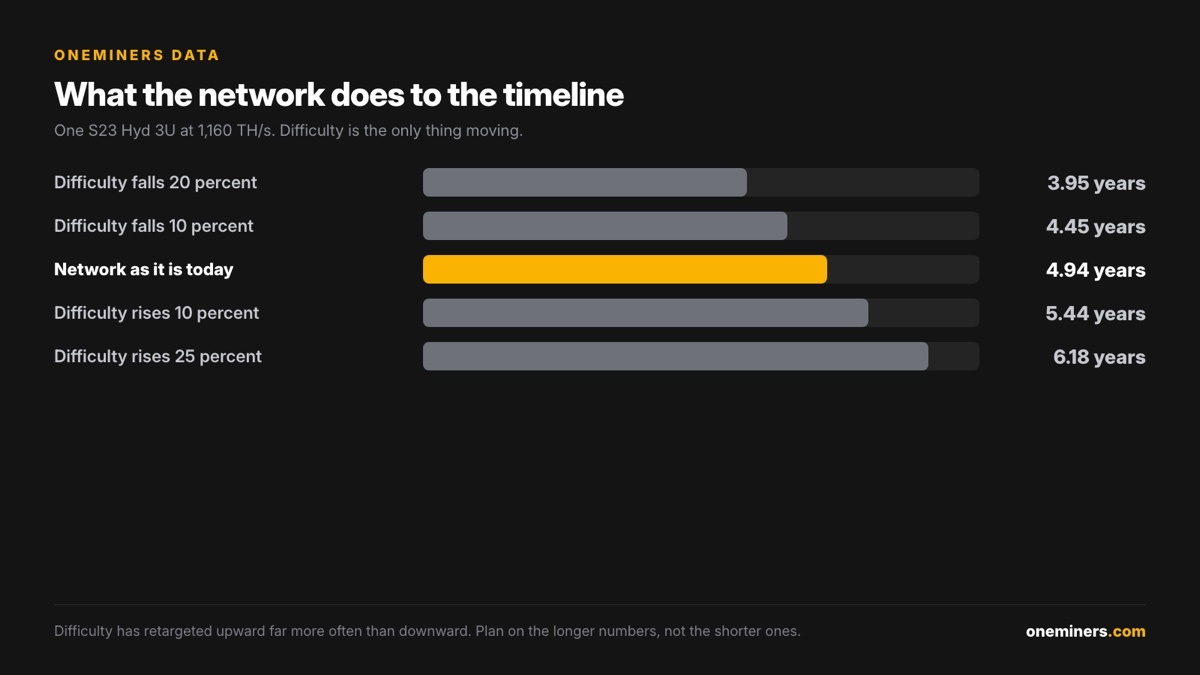
The Bitcoin network is running at about 950 EH/s, difficulty sits at 132.76 trillion at block height 967,975, and the next retarget is pointing down 2.0 percent. With Bitcoin near $84,834, hashprice works out at roughly $40.54 per petahash per day. Difficulty and height are from the live chain, price from blockchain.info, the retarget estimate from mempool. Those are the only four inputs anyone needs.
There are two honest answers to this question and they are about a million times apart, which is why it causes so much confusion.
The network mines a block every ten minutes on average, and each block pays 3.125 Bitcoin plus fees. So across the whole world, one Bitcoin is produced roughly every 3.2 minutes. A single machine is a tiny fraction of that network, so its own share arrives very slowly. The best unit in the catalogue today takes about 4.9 years to accumulate one whole Bitcoin. Both statements are true at the same time.
The rest of this page shows the arithmetic, machine by machine, so you can check it against your own hardware.
Key takeaways
The arithmetic, in two steps
Step one, work out what the machine earns per day. Hashprice is the daily revenue of one petahash per second of mining power, so:
daily revenue = hashprice x (your TH/s / 1000)
Step two, divide the Bitcoin price by that daily revenue, and you have the number of days to one whole coin:
days to 1 BTC = Bitcoin price / daily revenue
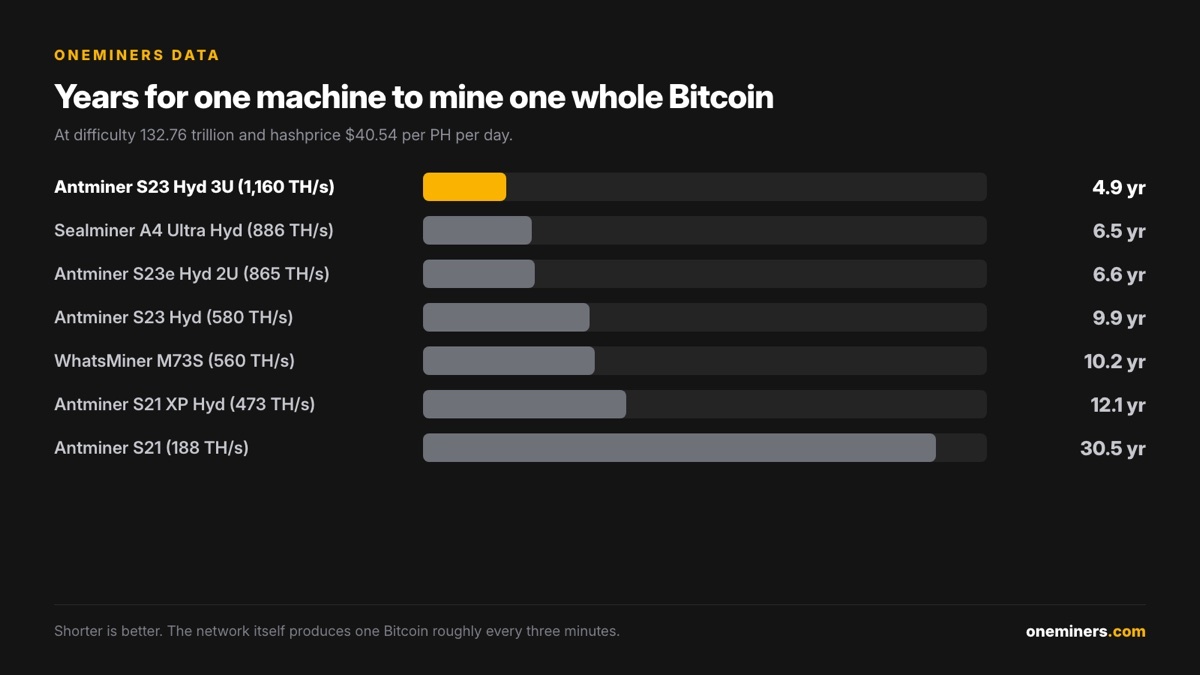
Worked example on the Antminer S23 Hyd 3U. At 1,160 TH/s and a hashprice of $40.54 per petahash per day, it earns about $47.02 a day, which is 0.000554 Bitcoin. Divide $84,834 by that and you get about 1,804 days, or 4.9 years. Note what this assumes: today's difficulty and today's price, held still. Neither of them will be.
Time to one Bitcoin, machine by machine
| Bitcoin miner | Hashrate | Mined per day | Days to 1 BTC | In years | Machines for 1 BTC a year |
|---|---|---|---|---|---|
 Antminer S23 Hyd 3U Antminer S23 Hyd 3U |
1,160 TH/s | 0.000554 BTC | 1,804 days | 4.9 years | 4.9 |
 Sealminer A4 Ultra Hyd Sealminer A4 Ultra Hyd |
886 TH/s | 0.000423 BTC | 2,362 days | 6.5 years | 6.5 |
 Antminer S23e Hyd 2U Antminer S23e Hyd 2U |
865 TH/s | 0.000413 BTC | 2,419 days | 6.6 years | 6.6 |
 Antminer S23 Hyd Antminer S23 Hyd |
580 TH/s | 0.000277 BTC | 3,608 days | 9.9 years | 9.9 |
 WhatsMiner M73S WhatsMiner M73S |
560 TH/s | 0.000268 BTC | 3,737 days | 10.2 years | 10.2 |
 Antminer S21 XP Hyd Antminer S21 XP Hyd |
473 TH/s | 0.000226 BTC | 4,424 days | 12.1 years | 12.1 |
 Antminer S21 Antminer S21 |
188 TH/s | 0.000090 BTC | 11,131 days | 30.5 years | 30.5 |
Calculated at difficulty 132.76 trillion and a hashprice of $40.54 per PH per day, 21 September 2026. Revenue only, before electricity.
Years to one Bitcoin, by machine
Shorter is better. Same network, same difficulty, different hardware.
Scale: years for one machine to mine one whole Bitcoin
The entry machine takes over thirty years on its own. This is why mining is measured in racks rather than in units.
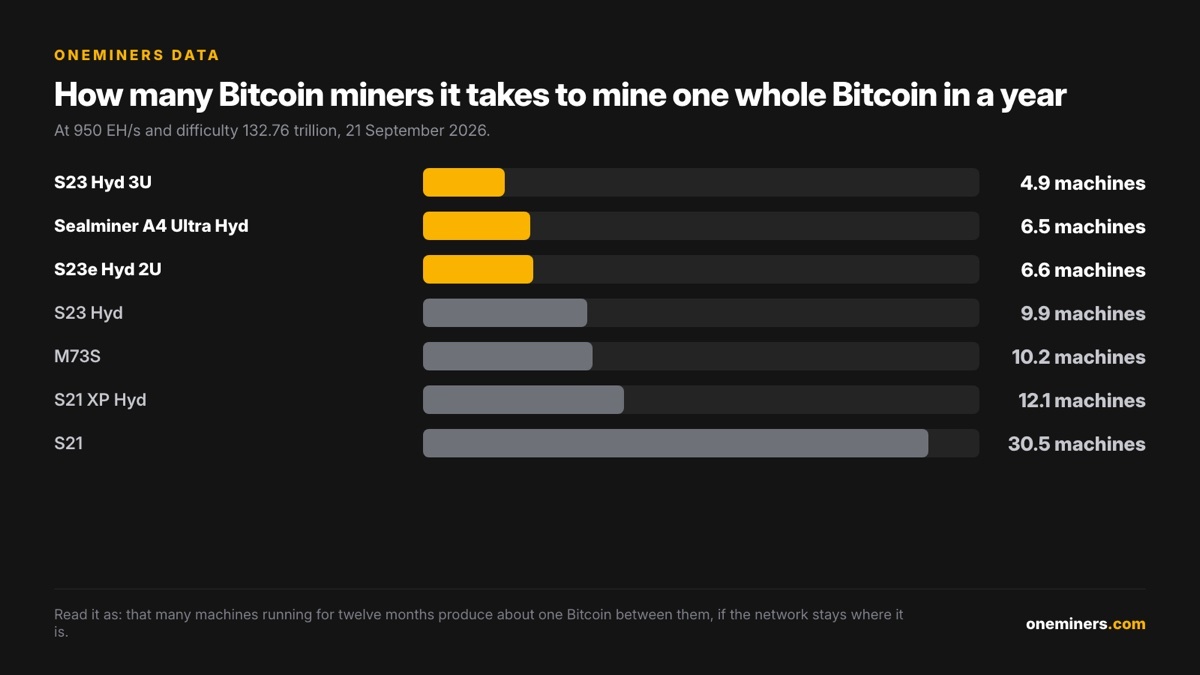
The more useful question: how many machines for one Bitcoin a year?
Nobody actually waits for one machine to finish. The practical version of this question is how much hardware it takes to produce one Bitcoin within a year, and the answer is the last column of the table above.
About 4.9 units of the Antminer S23 Hyd 3U, or about 30 units of the entry Antminer S21. That is the single clearest illustration of why efficiency and machine class matter: the same one Bitcoin a year needs six times as many entry machines as flagship ones, and each of those entry machines has its own power bill.
Which is why the practical planning order is rate first, hardware second. A rack of machines from the full miner catalogue running at 4.80 cents per kilowatt hour, or 3.64 cents on a seven year prepaid contract at the Nigeria hosting center, reaches one Bitcoin a year on a power bill that a household tariff could not support for a month.
Antminer S23 Hyd 3U$28,399Hashrate1,160 TH/sEfficiency9.50 J/THPower draw11,020 WBreaks even at$0.178/kWhPower at 4.80 cents$12.70/dayView listing
Antminer S23e Hyd 2U$19,440Hashrate865 TH/sEfficiency10.00 J/THPower draw8,650 WBreaks even at$0.169/kWhPower at 4.80 cents$9.96/dayView listing
Sealminer A4 Ultra Hyd$9,999Hashrate886 TH/sEfficiency9.45 J/THPower draw8,372 WBreaks even at$0.179/kWhPower at 4.80 cents$9.64/dayView listing
The three shortest routes to one Bitcoin in the live catalogue, ranked by time rather than by price.
First, the stakes: the waiting is not free
Electricity is 75 to 85 percent of the ongoing cost of running an ASIC. Rack space, technicians, cooling maintenance, insurance and monitoring are rounding errors next to it. That is why almost every honest question about mining collapses into one question about your power bill.
While a machine spends years accumulating a coin, it is burning electricity every one of those days. A Antminer S23 Hyd 3U takes about 1,804 days to mine one Bitcoin and will spend roughly $22,902 on electricity getting there at 4.80 cents per kilowatt hour. At a 17 cent household rate the same wait costs about $81,113, which is more than the coin is worth. The time is identical. Only the bill differs.
What the wait costs, hosted against household
Same machine, same number of days, two electricity contracts.
For scale, one Bitcoin is worth $84,834. Every dark bar on this chart is close to or above that line.

Four things that change the answer
Final thoughts
One Bitcoin every three minutes for the network, 4.9 years for the best single machine on the shelf. The number that moves between those two is how much hashrate you own and what you pay to run it. Time is fixed by the protocol and shared by everyone. The electricity bill during that time is the only part you negotiate. It is arithmetic, not marketing.
Size it properly: check the hosting rate first, then pick the Bitcoin miner with the shortest time to one whole coin.
Compare hosting locationsBrowse the miner catalogueFrequently asked questions
How long does it take to mine 1 Bitcoin?
For the whole network, about 3.2 minutes. For one modern machine, between 4.9 and 30 years depending on the unit, at today's difficulty.
How many miners do I need to mine 1 Bitcoin a year?
About 4.9 of the top unit, or about 30 entry-level machines, at current difficulty and before any difficulty change.
Does a higher Bitcoin price make mining faster?
No. Price changes what the coin is worth, not how quickly you accumulate it. Only your share of network hashrate and the block subsidy change the speed.
Why do online calculators disagree?
Mostly because they use different network hashrate estimates. Difficulty-implied hashrate and observed three-day averages can differ by around ten percent, which moves every result.
What happens to mining time after the 2028 halving?
It doubles. The subsidy drops from 3.125 to 1.5625 Bitcoin per block, so the same machine takes twice as long to reach one whole coin.
Informational only, not financial advice. Every figure above is a snapshot taken on 21 September 2026 and is derived from the live Bitcoin network and the live OneMiners catalogue. Mining revenue moves with price, difficulty and transaction fees, and can fall as well as rise. No fixed return is offered or implied. Do your own research before buying hardware or hosting.


