


ONEMINERS - THE COST OF ONE BITCOIN
How Much Does It Cost to Mine 1 Bitcoin in 2026?
One line of arithmetic answers it. At a household electricity rate, mining a whole Bitcoin costs more than the Bitcoin is worth. At a hosted rate it costs a fraction of one.
Live network data, live catalogue prices, published hosting rates. Check every number yourself.
The Bitcoin network is running at about 950 EH/s, difficulty sits at 132.76 trillion at block height 967,975, and the next retarget is pointing down 2.0 percent. With Bitcoin near $84,834, hashprice works out at roughly $40.54 per petahash per day. Difficulty and height are from the live chain, price from blockchain.info, the retarget estimate from mempool. Those are the only four inputs anyone needs.
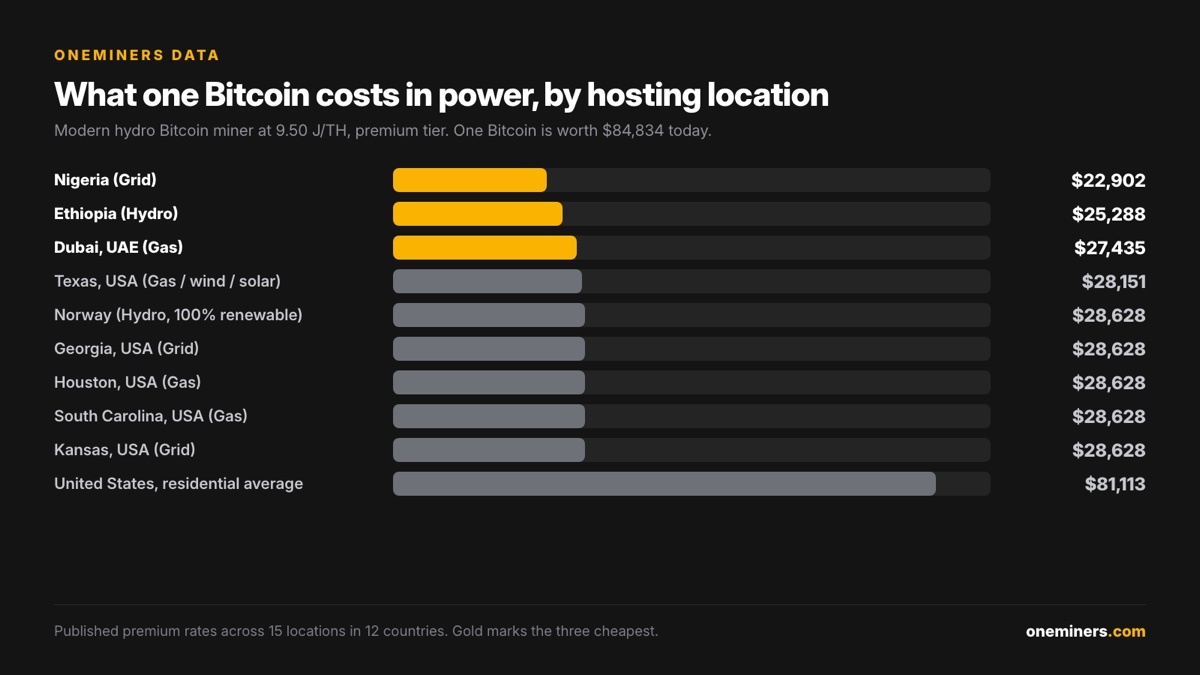
Here is the short version. Mining one whole Bitcoin today costs about $22,902 in electricity on a modern hydro machine at a hosted rate of 4.80 cents per kilowatt hour. The same machine on an average United States household tariff of 17 cents burns about $81,113 of electricity to produce the same one Bitcoin, which is close to the price of the coin itself. Same machine. Same network. Different power bill.
That is the whole article in a paragraph, and the rest of it shows the working so you can redo it with your own numbers. OneMiners publishes every hosting rate used below on its own location pages, so none of this has to be taken on trust.
Key takeaways
The formula, and why it is the only one you need
Every ASIC has an efficiency number measured in joules per terahash, written J/TH. Lower is better. From that one number you can calculate the exact electricity price at which the machine earns precisely enough to cover its own power and nothing more. That is the break-even rate:
break-even dollars per kWh = hashprice / (24 x J/TH)
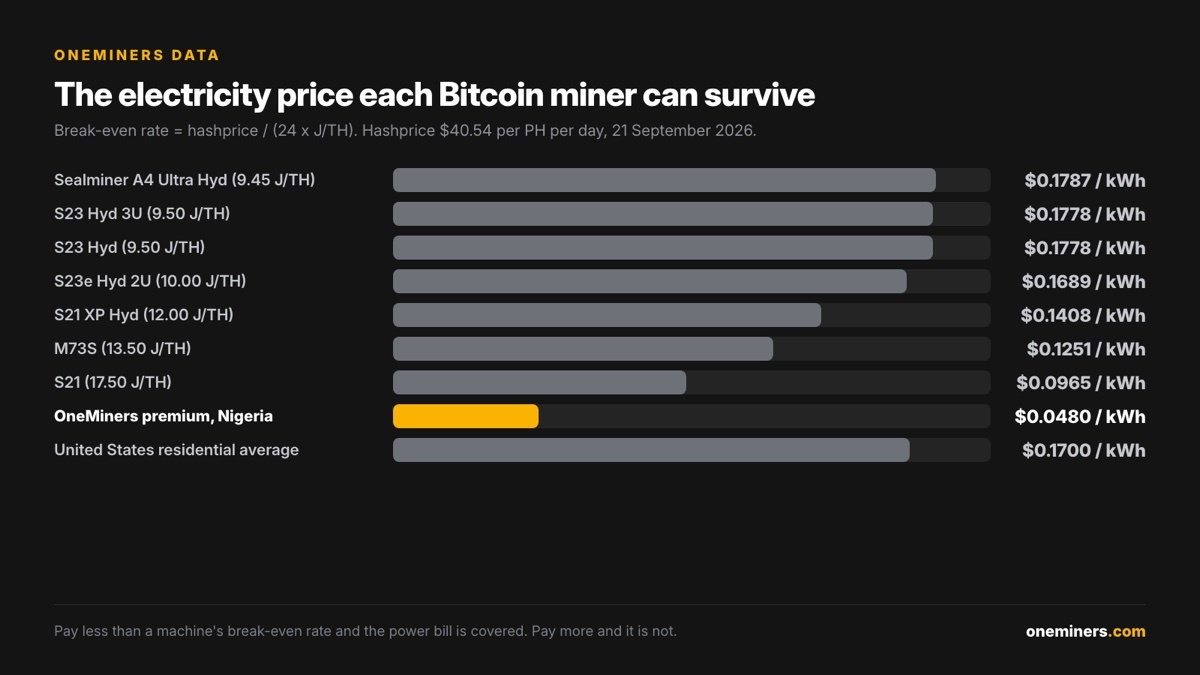
At today's hashprice of $40.54 per petahash per day, a 9.50 J/TH machine breaks even at $0.1778 per kilowatt hour. A 17.50 J/TH machine breaks even at $0.0965. Once you have that, the cost of a whole Bitcoin follows immediately:
electricity cost of 1 BTC = Bitcoin price x (your rate / your break-even rate)
Try it. Bitcoin is $84,834. A hosted rate of 4.80 cents divided by a break-even of $0.1778 gives 0.27. Multiply: about $22,902. The elegant part is what happens when your rate equals your break-even rate. The ratio becomes one, and the electricity cost of a Bitcoin becomes exactly the price of a Bitcoin. That is the line everything in mining is measured against.
First, the stakes: why the power price decides it
Electricity is 75 to 85 percent of the ongoing cost of running an ASIC. Rack space, technicians, cooling maintenance, insurance and monitoring are rounding errors next to it. That is why almost every honest question about mining collapses into one question about your power bill.
Put a number on it. A flagship Antminer S23 Hyd 3U drawing 11,020 watts costs $12.70 a day in electricity at 4.80 cents, and $44.96 a day at a United States household rate. Over a year that single machine is a swing of $11,777. Nothing else in the operation moves by that much.
Electricity cost of one Bitcoin, machine by machine
These are live catalogue machines with live specs. The break-even column is the formula above. The last two columns are what one whole Bitcoin costs in electricity, at a hosted rate and at a household rate.
| Bitcoin miner | Hashrate | Efficiency | Breaks even at | 1 BTC at 4.80 cents | 1 BTC at 17 cents |
|---|---|---|---|---|---|
 Antminer S23 Hyd 3U Antminer S23 Hyd 3U |
1,160 TH/s | 9.50 J/TH | $0.178/kWh | $22,902 | $81,113 |
 Sealminer A4 Ultra Hyd Sealminer A4 Ultra Hyd |
886 TH/s | 9.45 J/TH | $0.179/kWh | $22,782 | $80,686 |
 Antminer S23e Hyd 2U Antminer S23e Hyd 2U |
865 TH/s | 10.00 J/TH | $0.169/kWh | $24,108 | $85,382 |
 Antminer S23 Hyd Antminer S23 Hyd |
580 TH/s | 9.50 J/TH | $0.178/kWh | $22,902 | $81,113 |
 WhatsMiner M73S WhatsMiner M73S |
560 TH/s | 13.50 J/TH | $0.125/kWh | $32,546 | $115,265 |
 Antminer S21 XP Hyd Antminer S21 XP Hyd |
473 TH/s | 12.00 J/TH | $0.141/kWh | $28,929 | $102,458 |
 Antminer S21 Antminer S21 |
188 TH/s | 17.50 J/TH | $0.097/kWh | $42,189 | $149,418 |
Electricity only, no hardware cost. Hashprice $40.54/PH/day, Bitcoin $84,834, 21 September 2026. Live specs and prices from the OneMiners catalogue.
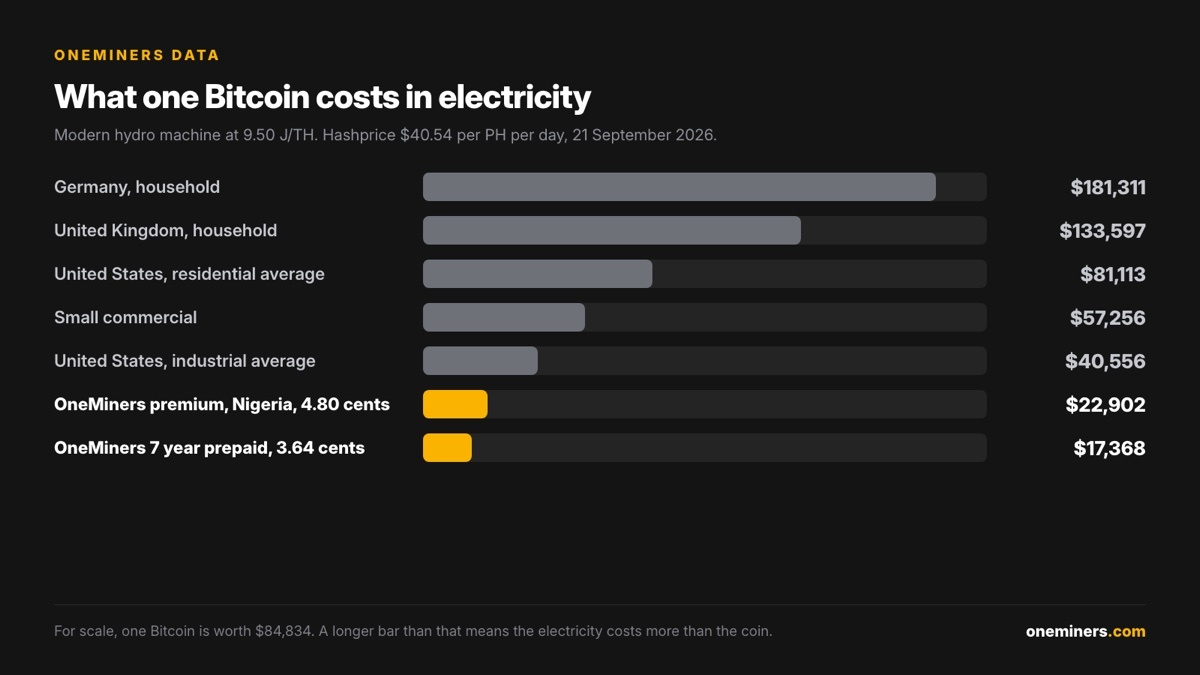
What one Bitcoin costs in electricity, by power price
Modern hydro machine at 9.50 J/TH. Hashprice $40.54 per PH per day.
Scale: US dollars of electricity per Bitcoin mined
For scale, Bitcoin itself is $84,834. Any bar longer than that is a machine spending more on electricity than the coin it produces is worth.
Two bars on that chart are longer than the price of a Bitcoin. A German household tariff and a British household tariff both cost more in electricity than the coin is worth, which is the plainest possible answer to whether home mining works in Western Europe in 2026.
The machines these numbers come from
Every figure above is derived from real hardware currently in stock, not from a reference table. Three of the units that set the pace:
Antminer S23 Hyd 3U$28,399Hashrate1,160 TH/sEfficiency9.50 J/THPower draw11,020 WBreaks even at$0.178/kWhPower at 4.80 cents$12.70/dayView listing
Sealminer A4 Ultra Hyd$9,999Hashrate886 TH/sEfficiency9.45 J/THPower draw8,372 WBreaks even at$0.179/kWhPower at 4.80 cents$9.64/dayView listing
Antminer S23 Hyd$12,299Hashrate580 TH/sEfficiency9.50 J/THPower draw5,510 WBreaks even at$0.178/kWhPower at 4.80 cents$6.35/dayView listing
Live listings. Efficiency is derived from published wattage divided by hashrate, not copied from a spec sheet.
The second cost: the machine itself
Electricity is the recurring cost. The hardware is the one-off. People new to mining usually assume the machine is the big number, and for the first few months it is. Over the life of the unit it is not.
Machine price against its seven year power bill
Hosted at the cheapest published premium rate. At a household rate the dark bars roughly triple.
The cheaper the machine, the more lopsided this gets. An entry unit can burn several times its own purchase price in electricity before it retires.
The Antminer S21 is the clearest case. It costs $1,111 and will draw about $9,684 of electricity over seven years at 4.80 cents per kilowatt hour, roughly 9 times its own price. Buying the machine is the easy decision. Buying the next seven years of electricity is the real one.
This is also why the two costs should be chosen together rather than in sequence. A unit picked from the full miner catalogue at 4.80 cents per kilowatt hour, or 3.64 cents on a seven year prepaid contract at the Nigeria hosting center, has a completely different lifetime cost from the same unit on a household tariff. The hardware decision is small. The electricity decision runs for seven years.

What people get wrong about this number
Final thoughts
The cost of mining one Bitcoin is not a fact about Bitcoin. It is a fact about your electricity contract. At 3.64 cents it is roughly $17,368. At 17 cents it is roughly $81,113. The network does not care which one you are paying, and that is exactly why the rate is the only part of the equation worth negotiating hard. Hardware is a purchase. Electricity is the business.
Work out your own number: pick a rate, pick a Bitcoin miner, and check the arithmetic against the live catalogue.
Compare hosting locationsBrowse the miner catalogueFrequently asked questions
How much does it cost to mine 1 Bitcoin in 2026?
In electricity alone, about $22,902 on an efficient hydro machine at a hosted rate of 4.80 cents per kilowatt hour, and about $81,113 at an average United States household rate. Hardware cost is separate.
Is it cheaper to mine Bitcoin or just buy it?
At a household electricity rate, mining is usually the more expensive route, because the electricity alone can exceed the $84,834 price of the coin. At an industrial or hosted rate the electricity cost is a fraction of the price, which is the entire reason industrial mining exists.
Does the machine price change the cost per Bitcoin?
Yes, if you amortise it. The figures above are electricity only, which is the standard way the industry quotes cost per coin. Add the purchase price spread over the machine's life to get your all-in number.
Why do published estimates vary so widely?
Because they assume different electricity rates and different hardware. A published range of roughly 38,000 to 92,000 dollars per coin is really a range of power prices wearing a disguise.
What happens to this number at the next halving?
It doubles. The same electricity produces half as much Bitcoin, so the cost per coin doubles on the day the subsidy halves, at roughly April 2028, unless price or fees move to compensate.
Informational only, not financial advice. Every figure above is a snapshot taken on 21 September 2026 and is derived from the live Bitcoin network and the live OneMiners catalogue. Mining revenue moves with price, difficulty and transaction fees, and can fall as well as rise. No fixed return is offered or implied. Do your own research before buying hardware or hosting.


