


Antminer X9 Cancelled? Bitmain Appears to Pull the Model Before Launch — What It Means for Monero Mining
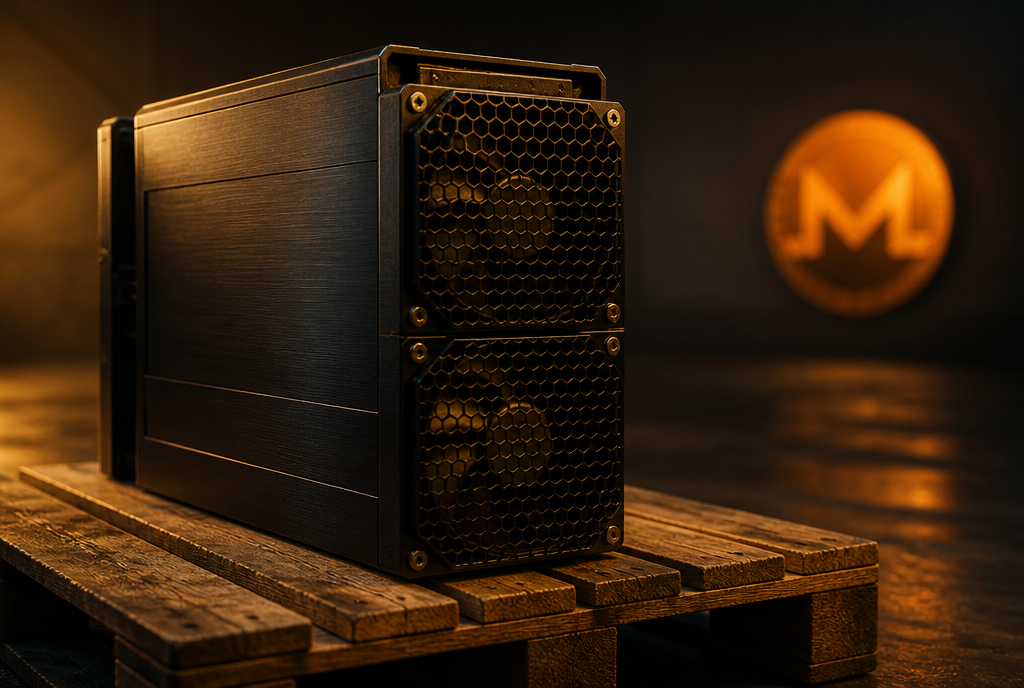
A quiet bomb just went off in the crypto-mining world. According to market signals and industry chatter, Bitmain — the world’s largest ASIC manufacturer — appears to be pulling the plug on its highly anticipated Antminer X9 (1,000 KH/s, i.e. ~1 MH/s) for the RandomX algorithm that secures Monero (XMR). The timing is brutal: plenty of miners already had their orders lined up and their capital committed.
Read this before you read anything else: this is a signal, not a confirmed announcement
- At the time of writing there has been no official statement from Bitmain confirming any cancellation.
- Everything circulating right now comes from the market — supplier back-channels, community reactions, and reseller feedback — not from an official Bitmain press release.
- So treat it as a strong, well-founded rumor, not corporate fact. That distinction matters enormously for what you do with your money next (more on that below).
Here’s the fresh view from the market: what appears to be happening, why the X9 may be heading for the history books before it ever ships, and what it means for owners of the older Antminer X5.
📉 Why would Bitmain “axe” its own flagship?
The unofficial talk points vaguely to “technical adjustments and a new strategy.” But the reality behind the scenes is far more interesting — and it has almost nothing to do with engineering. The most likely driver is hard resistance from the Monero community itself.
To understand why, you have to understand what makes Monero different. Where Bitcoin welcomes ASICs, Monero has spent years actively fighting them.
Quick primer: what “ASIC-resistance” actually means
- An ASIC is a chip built to do one job insanely fast — here, hashing one specific algorithm. It crushes ordinary computers at that task.
- RandomX is the algorithm Monero adopted in November 2019. It was deliberately designed to run best on ordinary CPUs — the processor in any laptop — so that everyday people can mine, and no factory can dominate the network.
- ASIC-resistance is Monero’s standing policy of keeping mining spread across many small players. Concentrated hashpower is seen as a threat to the whole point of the coin.
This isn’t theoretical. Monero has done this before — more than once. Back in early 2018, when the first Monero ASICs appeared, the developers pushed a hard-fork that changed the algorithm and turned those brand-new machines into scrap almost overnight. They followed up with scheduled tweaks to keep ASIC makers off-balance, and eventually moved to RandomX specifically to slam the door shut. The community has a proven playbook, and it is not shy about using it.
The moment word spread that the X9 would push a full 1 MH/s, the community immediately started planning an emergency hard-fork — a change to the algorithm that would turn those expensive ASICs into nothing but noisy space heaters overnight.
Now put yourself in Bitmain’s shoes. Selling thousands of machines that could stop working a week after delivery isn’t just a bad quarter — it’s a reputation catastrophe. Angry customers, refund demands, and a very public reminder that Monero can brick your hardware on a whim. Seen that way, a quiet withdrawal makes far more sense than a loud launch. Better to never ship than to ship a product the network is openly preparing to destroy.
🔄 What comes next? Talk of a “new model”
Chatter suggests the X9 could eventually be replaced by an entirely new machine, better tuned to the current state of the network rather than picking a fight with it.
What the rumor mill expects (speculation, not a roadmap)
- Lower hashrate on purpose. A machine that runs well below 1 MH/s so it doesn’t “provoke” Monero’s developers into an instant fork.
- A negotiated balance. Enough performance to be worthwhile for miners, but not so much that it threatens decentralization or opens the door to a 51% attack on the network.
- A slower, quieter rollout. Less “flagship launch,” more “see if the community tolerates it.”
Again: this is speculation, not a published roadmap. Until Bitmain says something on the record, nobody — including us — should plan around a specific model, spec, or release date.
❓ And the Antminer X5? Is it still safe?
There’s actual good news here for owners of the Antminer X5 (212 KH/s). With the X9 staying off the market, network difficulty on Monero won’t spike as dramatically as many X5 owners feared. A flood of 1 MH/s machines would have raised the bar for everyone; without them, the competitive landscape stays gentler.
| Time Horizon | What It Means for Your X5 | Status |
|---|---|---|
| Right now | Still hashing, still working. At an electricity price around $0.0525/kWh it remains profitable to run. | OK |
| The near future | “Tolerated” by the community because 212 KH/s isn’t a serious threat to decentralization — nowhere near the danger zone a 1 MH/s wave would have hit. | Watch |
| Whenever a new gen lands | The moment any newer, more efficient RandomX machine truly arrives, the X5’s relative efficiency inevitably drops. That’s the normal hardware cycle, not a Monero-specific risk. | Fades |
The short version: the X5 isn’t going anywhere overnight. It sits comfortably under the radar precisely because it isn’t powerful enough to alarm anyone. Its real enemy isn’t a fork — it’s ordinary generational obsolescence, and that’s a slower, more predictable clock.
The core risk, in one sentence
ASIC mining of Monero has always been a kind of guerrilla warfare — a constant duel between the hardware makers and the software developers. And here’s the exact risk you carry if you pre-pay for a RandomX machine and simply wait:
You could hand over your capital, wait weeks or months for delivery, finally receive the ASIC — and then watch Monero’s developers change the algorithm and turn your expensive miner into a useless box.
That’s not fear-mongering. It’s literally what happened to the first wave of Monero ASIC buyers in 2018. The pattern is real, it is documented, and with the X9 rumor swirling it is very much live again.
💡 The OneMiners recommendation — and a unique way to protect your capital
Because there’s no official confirmation either way, we don’t think you should have to gamble on it. So OneMiners is offering our clients something you simply won’t get from a standard reseller — a structure built around one goal: keeping your capital safe while the situation clears up.

How the OneMiners “hold & redeploy” approach works
- We hold your X9 order for you. If the X9 — or its successor — actually launches in a form that genuinely makes sense to mine, we keep your place in line and secure the unit for you the moment it’s truly available.
- In the meantime, your capital doesn’t sit frozen. Instead of parking money in a machine that might never ship — or might arrive already forked into a brick — we redeploy your funds into hardware that is profitable today and carries none of that algorithm-change risk. Think proven ZEC machines like the Z15 Pro, where no developer team can suddenly rewrite the rules and switch off your ASIC.
- You stay flexible. Your capital keeps working while things clear up. If and when a stable Monero machine truly exists, we move you into it — on your terms, not under pressure and not on a countdown.
Put simply: instead of taking on all the risk yourself and hoping for the best, you get a safety net. Your capital keeps working, you’re protected from the “expensive brick” scenario, and you still keep your spot in line if the X9 story turns out well. Two very different ways to play the same rumor:
Why does this work? Because coins like Zcash (ZEC) don’t share Monero’s war on ASICs. There’s no developer faction preparing to fork your machine into a paperweight, which makes proven ZEC hardware a genuinely stable place to keep your capital productive while the Monero picture resolves — instead of leaving it frozen in a pre-order that may never arrive intact.
Want a hand deciding?
Want help choosing more stable hardware where there’s no risk of the network suddenly switching off your machine — or want to set up an order we hold for you while your capital works elsewhere? Get in touch and we’ll walk through your options together — over a coffee at our service center in Prague, or online, whichever suits you.
You shouldn’t have to bet your capital on a rumor. Keep your spot — and keep your money working.
FAQ: The Antminer X9 & Monero Mining
1. Has Bitmain officially cancelled the Antminer X9?
No. As of this writing there is no official Bitmain statement confirming a cancellation. The signal comes entirely from supplier back-channels, reseller feedback, and community reaction — a strong rumor, not confirmed corporate news.
2. Why would Monero “brick” an ASIC?
Monero’s community follows a long-standing ASIC-resistance policy. When ASICs have appeared before (notably in 2018), developers hard-forked the algorithm to disable them and later adopted RandomX to keep mining CPU-friendly. A powerful new ASIC like a rumored 1 MH/s X9 is exactly the kind of thing that triggers that response.
3. Is my Antminer X5 (212 KH/s) still safe to run?
For now, yes. Its hashrate is low enough that the community “tolerates” it, and with the X9 apparently off the table, difficulty isn’t set to spike sharply. At an electricity price around $0.0525/kWh it remains profitable. Its main long-term risk is ordinary generational obsolescence, not a fork.
4. Should I pre-order an X9 from a reseller right now?
That’s the risky move. You’d lock up capital for a machine that might never ship — or could arrive after a fork has already disabled it. This is why OneMiners offers to hold your order while redeploying your capital into fork-proof hardware that’s profitable today.
5. What’s a more stable alternative while I wait?
Coins without Monero’s war on ASICs — such as Zcash (ZEC) — let proven hardware like the Z15 Pro run without the threat of a developer team switching it off. It’s a way to keep capital productive while the Monero situation clears up. Talk to OneMiners about the current options.


